 |
| (Illustration Friday: May 24, 2015) |

Thursday, May 30, 2013

Friday, May 24, 2013
Farewell
I tried to think of some other idea associated with this word, but once the song was in my head, there was no turning back. I can't get the video to embed here, but you can see the scene here: http://vimeo.com/31680681.
And, here's my illustration, finally done a month later (and Julie Andrews isn't even in this)! Now, the song can be in your head too.
And, here's my illustration, finally done a month later (and Julie Andrews isn't even in this)! Now, the song can be in your head too.
 |
| (Illustration Friday: April 26, 2013) |
Thursday, May 09, 2013
Johnny Kitties: Celebrating Johnny Depp Film #32--Charlie and the Chocolate Factory (2005)
[What is Johnny Kitties? See Johnny Kitties: Celebrating Johnny Depp for all the details.]

Who doesn't want this job?
Looking for an heir to his chocolate empire, reclusive chocolatier extraordinaire Willy Wonka (Johnny Depp) opens the gates of his factory to five children who have won Golden Tickets for a tour. As they get a behind-the-scenes glimpse into Wonka's twisted world, he weeds them out and finds the winner. But does the winner want the prize? Charlie and the Chocolate Factory is Tim Burton's take on Roald Dahl's classic book.
How dare they?
 The generations who grew up watching Gene Wilder as Willy Wonka in Willy Wonka and Chocolate Factory couldn't imagine another version. When I read the news that Tim Burton was "remaking" it with Johnny as the chocolatier, I was simultaneously ridiculously excited to see it and worried about the inevitable impending fury awaiting them from loyal fans of the original. I wasn't alone: "As soon as I said that I was in, I knew there were going to be great risks involved because we could very easily blow it," Johnny says. "But again, that's very exciting for an actor. It's a challenge. It's a very loved character, both from the book and Gene Wilder's brilliant performance from that earlier film. So, I knew that the risk was that I had to take it from somewhere far way from the area that Gene Wilder had stomped. There's a twisted, perverted kind of side to the character, and so I ran in the direction that seemed right to me."
Pretty quickly, everyone involved in the film clarified what they were doing: This movie is not a remake; their focus is to stay true to the book. To help with the distinction, the two films even have different titles. While I grew up watching and loving the Gene Wilder classic (and still do), I always think of this one as separate and different. This one is a Tim Burton movie, and Tim Burton movies are unmistakably Tim Burton movies. I knew it couldn't go near anything like Gene Wilder's Wonkavision. Tim Burton even had the Dahl family's blessing, with Felicity Dahl serving as one of the executive producers. Everything would be okay.
Really, what's the difference?
 "We just decided, when I got involved with it, to just go back to the basics and try to be as true to the book as we could be," Tim Burton says. Screenwriter John August can attest that Johnny was in on this plan too: "When I sat down with Johnny to talk about the character and as we were looking through the last three of four dialogue changes, what I loved is that he pulled out his Roald Dahl book and wanted to go through and add in a few extra lines from Dahl's original book." Dramatizing the book did call for some deviations, but it all seems to work. "Even with the things we added, we tried to at least channel the spirit of Roald Dahl," Tim Burton says.
The film spends more time exploring who Willy Wonka is: How did he become a chocolate magnate? Why did he close his factory for 20 years? Why does he need an heir? Once all those questions were answered, they added some closure to all his issues at the end. (Willy Wonka has some serious issues!)
I recently read a fan's take on the two films, observing that the Gene Wilder version focuses more on a child's innocent love for candy while Johnny's version shows the greedy side. I'd agree with that.
Willy Wonka is weird.
 Johnny's Willy Wonka didn't sit well with most critics who said he'd gone too far in the weirdo direction. I admit there are moments in this movie when I've agreed, but I blame the reviewers who contaminated my first impression. Once I heard what other people thought of it, I couldn't get those ideas out of my head. So, I won't repeat them here. (This is why you should never read reviews before seeing things for yourself.)
Despite the critics, this film did really well at the box office and is popular among a new generation of fans. These days, it's on TV just as often as Gene Wilder's version, and as I've watched it over the years, Johnny's Willy Wonka has really grown on me. He's supposed to be eccentric, bizarre, and questionable. Who pulls that off any better than Johnny? I admire his subtle moments amid the gam-show atmosphere in which, with a quick look or move, Johnny makes you wonder if you should feel sorry for Willy Wonka or call the police about him. As Felicity Dahl says of Johnny, "he just has that twist, that humor, that wickedness, that naughtiness, that delight that Wonka should have."
Johnny's first inspiration for Willy Wonka was a local children's television show host, "a guy who certainly puts on a face every day." Tim Burton explains further, "You don't question it as a kid, but as you got older, you kind of go, 'That guy was really wierd!' So, we sort of got into that kind of thinking about those kinds of people that stay in your subconscious somehow."
 Being a recluse for 20 years with only Oompa Loompas for company, Johnny figured that Willy Wonka is stuck in an era of the past, makes old references from that time, and doesn't know how to relate to people anymore, least of all children. This guy didn't get out in the sun, which is why he's so pale, and he has that awful haircut. (I think that haircut disturbs me more than anything else.)
As a result, at times, Johnny's laugh-out-loud funny in this movie, especially when interacting with his guests. "I always like working with Johnny because he's an actor who likes to try different things all the time, and that excites me," Tim Burton says. "And, each time I work with him, it gets better." Co-star David Kelly, who plays Grandpa Joe, agrees, "Watching Johnny, you can't see the wheels going round. You keep saying to yourself, 'how is he doing that?' I don't know!"
Welcome to the factory.
Aside from Johnny, the two other best things about this movie are the supporting cast and the production design.
The Costars
 Everyone is fantastic in their roles, including Helena Bonham Carter and Noah Taylor as Charlie's parents, David Kelly as Grandpa Joe, the three other grandparents (Eileen Essell, Mrs. Snow in Finding Neverland, among them), and all the other winners' parents. I can't imagine anyone else playing them.
The Oompa Loompas are all played by the same person, Deep Roy, who I think got the hardest job of all. Every shot of an Oompa Loompa doing something new--dancing, playing an instrument, making a face--is all him. They used a combination of animatronics and computer graphics to multiply his work in the musical numbers. For one scene, they may have shot him in various spots doing different things 60 times and then compiled everything together into one. His days must have been long.
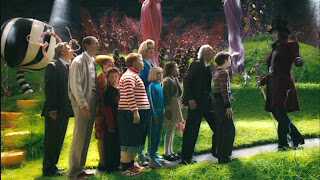 The biggest surprise was the amazing kids: Philip Wiegratz as Augustus Gloop, AnnaSophia Robb as Violet Beauregarde, Julia Winter as Veruca Salt, Jordan Frye as Mike Teavee, and Freddie Highmore as Charlie Buckett. "I was lucky," Tim Burton says of casting them. "I think, most of the time, when the right one walked in, I just sort of knew it." You may remember that Freddie Highmore did brilliant work with Johnny in Finding Neverland. Reunited here, he fits right in: "Not only did he look the part, but you could just tell he's an amazing person and has got a real gravity to him, a simple but very deep emotional depth," Tim Burton says. "There was just no question about it!" But more impressive is that some of the kids had little or no experience in movies. Can you imagine your first movie being this one? There's a Golden Ticket prize for you! "They're just an incredibly varied bunch of kids, and they're just great fun to be around and great company," Adam Godley, who plays Mike Teavee's dad, says. "They keep us all in tune with what this whole project is really about and who it's really for."
Willy Wonka's World
I love that Tim Burton goes old school: As much as possible, he had real sets built so the actors could really get a feel for it. "Willy Wonka--It's kind of all about texture," he explains. "It was important for us to build the sets, make a real chocolate river, make a real chocolate waterfall....To have as many real things for them to react to, I think, was really important. If you're in one of those green screen rooms for too long, you know, you start to go kind of nuts after a while."
 The rooms in the factory are a treat for the senses; each is unique with its own character. As Johnny describes it, "the factory itself is like walking through Wonka's brain--complicated, strange, fun, disturbing, outrageous." Only on a Tim Burton movie would you have Squirrel Training Camp for a scene in the Nut Room. Again, they used a combination of animatronics and computer graphics. For this scene, they created a room full of 200 busy squirrels on the job, 40 of which are real, very talented nutcrackers.
 The Chocolate Room is the stunner, where edible delights abound! Johnny remembers visiting Pinewoods Studio early on in production and seeing the production designer practicing chemistry in a bucket to concoct the perfect chocolaty mixture. "I came back a couple months later, and the bucket had turned into huge vats. There were millions of liters of this chocolate flowing!" It took them 5 days to fill the studio with it. Seeing the final result, Felicity Dahl approves: "When I went to Pinewood and saw the whole of the Pinewood lot covered in Wonka, I knew if Roald had seen that, he would have just said, 'This is what I had in my mind.'"
Charlie and the Chocolate Factory was nominated for an Oscar for costume design. While it didn't win that, it was nominated for a bunch of other awards and won a couple for favorite family film. Freddie Highmore won a best actor award from the Broadcast Film Critics. And, despite his controversial performance, Johnny earned a couple of acting awards too. Was there ever any doubt?
The Kitties are all about the candy.
On February 1, Willy Wonka opened his factory gates to five children and their parents for a tour. With the Oompa Loompas (Simon) always on the job, Willy Wonka whittles down his choices to find the perfect heir to his fortune. Greedy Agustus Gloop (Norman) gets sucked out of The Chocolate Room. Competitive Violet Beauregarde (Mini) balloons into a blueberry. Squirrels toss spoiled Veruca Salt (Lily) down the garbage shoot, and cheater (or "Mumbler!") Mike Teavee (B.J.) shrinks down to size after he breaks some rules. In the end, both Charlie (Comet), who inherits the candy-making business, and Willy Wonka, who is warmly welcomed into Charlie's family, are the lucky winners!
![Johnny Kitties: Celebrating Johnny Depp Film #32--Charlie and the Chocolate Factory (2005) [February 23, 2013]](https://lh3.googleusercontent.com/blogger_img_proxy/AEn0k_shkNf5GzI85NqrhQHiL0Q4-yPNU2lCUuf48zNm9ssy8PJw87TT1bxirVbXpUHCsgCc9JomEA1YtX-qZxMRYmmwO2ix5-cXAMlnxKmTG89wU-kIu4YCzKrFAfzWcmuQVB-u=s0-d)
What's Next?
Johnny gets animated and accidentally married in Tim Burton's Corpse Bride!
Image credits: Charlie and the Chocolate Factory Images © Warner Brothers Pictures; image of Tim Burton with Johnny Depp © unknown; illustration © Melissa Connolly

Who doesn't want this job?
Looking for an heir to his chocolate empire, reclusive chocolatier extraordinaire Willy Wonka (Johnny Depp) opens the gates of his factory to five children who have won Golden Tickets for a tour. As they get a behind-the-scenes glimpse into Wonka's twisted world, he weeds them out and finds the winner. But does the winner want the prize? Charlie and the Chocolate Factory is Tim Burton's take on Roald Dahl's classic book.
How dare they?

Pretty quickly, everyone involved in the film clarified what they were doing: This movie is not a remake; their focus is to stay true to the book. To help with the distinction, the two films even have different titles. While I grew up watching and loving the Gene Wilder classic (and still do), I always think of this one as separate and different. This one is a Tim Burton movie, and Tim Burton movies are unmistakably Tim Burton movies. I knew it couldn't go near anything like Gene Wilder's Wonkavision. Tim Burton even had the Dahl family's blessing, with Felicity Dahl serving as one of the executive producers. Everything would be okay.
Really, what's the difference?

The film spends more time exploring who Willy Wonka is: How did he become a chocolate magnate? Why did he close his factory for 20 years? Why does he need an heir? Once all those questions were answered, they added some closure to all his issues at the end. (Willy Wonka has some serious issues!)
I recently read a fan's take on the two films, observing that the Gene Wilder version focuses more on a child's innocent love for candy while Johnny's version shows the greedy side. I'd agree with that.
Willy Wonka is weird.

Despite the critics, this film did really well at the box office and is popular among a new generation of fans. These days, it's on TV just as often as Gene Wilder's version, and as I've watched it over the years, Johnny's Willy Wonka has really grown on me. He's supposed to be eccentric, bizarre, and questionable. Who pulls that off any better than Johnny? I admire his subtle moments amid the gam-show atmosphere in which, with a quick look or move, Johnny makes you wonder if you should feel sorry for Willy Wonka or call the police about him. As Felicity Dahl says of Johnny, "he just has that twist, that humor, that wickedness, that naughtiness, that delight that Wonka should have."
Johnny's first inspiration for Willy Wonka was a local children's television show host, "a guy who certainly puts on a face every day." Tim Burton explains further, "You don't question it as a kid, but as you got older, you kind of go, 'That guy was really wierd!' So, we sort of got into that kind of thinking about those kinds of people that stay in your subconscious somehow."

As a result, at times, Johnny's laugh-out-loud funny in this movie, especially when interacting with his guests. "I always like working with Johnny because he's an actor who likes to try different things all the time, and that excites me," Tim Burton says. "And, each time I work with him, it gets better." Co-star David Kelly, who plays Grandpa Joe, agrees, "Watching Johnny, you can't see the wheels going round. You keep saying to yourself, 'how is he doing that?' I don't know!"
Welcome to the factory.
The Costars

The Oompa Loompas are all played by the same person, Deep Roy, who I think got the hardest job of all. Every shot of an Oompa Loompa doing something new--dancing, playing an instrument, making a face--is all him. They used a combination of animatronics and computer graphics to multiply his work in the musical numbers. For one scene, they may have shot him in various spots doing different things 60 times and then compiled everything together into one. His days must have been long.

Willy Wonka's World
I love that Tim Burton goes old school: As much as possible, he had real sets built so the actors could really get a feel for it. "Willy Wonka--It's kind of all about texture," he explains. "It was important for us to build the sets, make a real chocolate river, make a real chocolate waterfall....To have as many real things for them to react to, I think, was really important. If you're in one of those green screen rooms for too long, you know, you start to go kind of nuts after a while."

 The Chocolate Room is the stunner, where edible delights abound! Johnny remembers visiting Pinewoods Studio early on in production and seeing the production designer practicing chemistry in a bucket to concoct the perfect chocolaty mixture. "I came back a couple months later, and the bucket had turned into huge vats. There were millions of liters of this chocolate flowing!" It took them 5 days to fill the studio with it. Seeing the final result, Felicity Dahl approves: "When I went to Pinewood and saw the whole of the Pinewood lot covered in Wonka, I knew if Roald had seen that, he would have just said, 'This is what I had in my mind.'"
Charlie and the Chocolate Factory was nominated for an Oscar for costume design. While it didn't win that, it was nominated for a bunch of other awards and won a couple for favorite family film. Freddie Highmore won a best actor award from the Broadcast Film Critics. And, despite his controversial performance, Johnny earned a couple of acting awards too. Was there ever any doubt?
The Kitties are all about the candy.
On February 1, Willy Wonka opened his factory gates to five children and their parents for a tour. With the Oompa Loompas (Simon) always on the job, Willy Wonka whittles down his choices to find the perfect heir to his fortune. Greedy Agustus Gloop (Norman) gets sucked out of The Chocolate Room. Competitive Violet Beauregarde (Mini) balloons into a blueberry. Squirrels toss spoiled Veruca Salt (Lily) down the garbage shoot, and cheater (or "Mumbler!") Mike Teavee (B.J.) shrinks down to size after he breaks some rules. In the end, both Charlie (Comet), who inherits the candy-making business, and Willy Wonka, who is warmly welcomed into Charlie's family, are the lucky winners!
What's Next?
Johnny gets animated and accidentally married in Tim Burton's Corpse Bride!
Image credits: Charlie and the Chocolate Factory Images © Warner Brothers Pictures; image of Tim Burton with Johnny Depp © unknown; illustration © Melissa Connolly
Sunday, April 28, 2013
Train
Is it just me, or do you always think of Buster Keaton when someone mentions a train too?
This drawing was instantly inspired by a scene in one of Buster Keaton's best movies, The General (1926). You can see it here:
Now, see how brave Comet can be? (This seat is not recommended.)
This drawing was instantly inspired by a scene in one of Buster Keaton's best movies, The General (1926). You can see it here:
Now, see how brave Comet can be? (This seat is not recommended.)
 |
| (Illustration Friday: April 19, 2013) |
Monday, April 22, 2013
Wild!
When in the backyard, kitty instincts typically take over... Happy Earth Day, everyone!
 |
| (Illustration Friday: April 12, 2013) |
Friday, April 19, 2013
Hometown Glory
My heart has been with my hometown this week.

I think Stephen Colbert put it best:
Buckle on your hats and stay strong, Bostonians!

I think Stephen Colbert put it best:
Buckle on your hats and stay strong, Bostonians!
Tuesday, April 09, 2013
Johnny Kitties: Celebrating Johnny Depp Film #31--The Libertine (2004)
[What is Johnny Kitties? See Johnny Kitties: Celebrating Johnny Depp for all the details.]

My part was just a slice of the pie, and it felt great to have that collaboration with everybody--from the focus puller to the extras to the DP to the director. We were all in there swinging at the same beast and fighting for what was right. It was very intense, down and dirty, swinging and clawing the whole way. I'm very proud of the film.

It was a long, bumpy road.
 This movie was at least 10 years in the making. Talk of it would appear, disappear, and reappear while Johnny made other movies. It all started with John Malkovich, who starred as the Earl in The Libertine, the play, in Chicago in 1995. He got the playwright, Stephen Jeffreys, to adapt it to the screen. And, after working with Laurence Dunmore on a commercial, he hired him to direct the movie. He met Johnny for dinner and asked him to play the starring role. "Why don't you play the part?" Johnny asked, since John Malkovich had already received critical acclaim for the role in the play. "Because I want you to do it," he responded. Good choice!
The Libertine was plagued with financial, scheduling, and whatever other problems for years. I saw it as a labor of love among the small group of people involved from the very beginning, even though I knew nothing about the story or this guy it was all about. I wasn't sure if it would ever come to life.
By the time it did, I was excited to see it just because it had taken so long. Even during production, the British government cracked down on filmmakers shooting in Great Britain, closing a loophole for filming incentives and ultimately taking away more than 30% of production funding. Some films shooting there had to shut down completely and were lost, but The Libertine survived! "I think everyone across the board who was involved in this production put their hands into their own pockets," Director Laurence Dunmore says.
Before this film was released, the MPAA threatened to slap it with an NC-17 rating, unleashing the imaginations of Johnny Fans everywhere. I didn't know what all the fuss was about when I saw the film in the theater. It was only after the fact that I realized what I saw was rated R.
It was a muddy, mucky, chaotic world.
This movie is grimy in look and feel. And, being completely unfamiliar with John Wilmot, I even found his life story sometimes confusing to follow, but I guess it's because you can only fit so much into 2 hours. "Normally when you're faced with writing a dramatized biography, you invent a lot of stuff to make it more interesting," Writer Stephen Jeffreys says. "With Rochester, it was the other way around. I had to leave all this stuff out because it's so much." If you're really interested, the DVD's director's commentary is helpful in understanding all the background and course of events in Wilmot's life.

Even though I don't crave to watch this movie very often, every time I do watch it, I marvel at it all--the cinematography, direction, design, costumes, acting. This film has its own distinctive look, energy, and personality. Even if you didn't know all the trouble they went through to make it, you could feel the passion everyone involved felt for it. Every performance is fantastic. Though Rosamund Pike plays Wilmot's tormented wife in only a few scenes, she won a well-deserved British Independent Film Award for her amazing work.
While watching through the lens of a hand-held camera usually has me craving stillness after just a few minutes, it works so well in The Libertine that I don't even think about it. You feel as though you are there with them in that world. All these ingredients make for an extremely intimate film-going experience.
"I am up for it, all the time."

All his research revealed myriad layers of the man. "He was written off as a satirist, rogue, hedonistic lunatic, complete drunk, pornographer, and all those things, and he was all those things," Johnny says. "But he was also a beautiful poet. He was a loving father, a confused and tormented husband. He was a very tortured man. He was obsessed with honesty. He couldn't allow for a lie. He had no tolerance for it from anyone, not even from King Charles, which got him in a lot of trouble. I salute that!"
But even the king couldn't deny Wilmot's talent, which at times was the only thing that held their strained relationship together. "He was a guy who was, I think, probably two or three hundred years ahead of his time," Johnny says of the Earl. Stephen Jeffreys agrees, "Nobody writes like Rochester. Nobody wrote before him like that. Nobody really writes in the same vain about sexuality until the 20th century." But I think Samantha Morton sums up the man most efficiently: "He was a poet, an artist, and revolutionary of his day. And if he were alive today, he'd be certainly very rock and roll!"
Johnny rocks it!
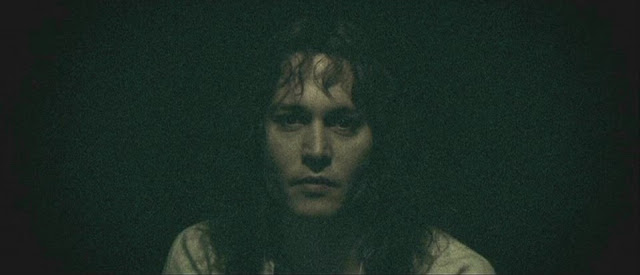
"From an actor's standpoint, when you read that opening monologue and then the ride commences, you know when you're reading that beautiful dialogue and these incredible scenes--one after the next--that you'll never ever see the likes of it again," he says. Since the movie is based on a play, it very much feels like one because of the heavy dialogue and long scenes. Wouldn't it be fantastic if Johnny were ever in a play? Well, this is as close as you're going to get for now.

Of course, Johnny's dedication goes deeper than saying some gorgeous prose. He got to know the person behind the story and how he really lived. "Why? How do you arrive there? How do you arrive at that need for such excess and the need for self-medication because I don't think it was about fun for him," he says of Wilmot. "My angle was ultimately an attempt to understand the guy, and then trying my best to please him. It's ultimately a kind of love letter to him. Hopefully it comes off that way."
Long before shooting began, Johnny and Laurence Dunmore worked collaboratively on his character and how Wilmot impacted everything, from the cast and story to the movie as a whole. "Our process was one of continual discussion. It was a constant collaboration and a constant evolution that I certainly found immensely rewarding," the director says. "Johnny was very engaged and absorbed in Rochester as a man, as a historical figure, and as a writer. I think we were both informed and yet we were also empowered to interpret Rochester and how he comes across on screen."


Who knew Gordon could get there too?
![Johnny Kitties: Celebrating Johnny Depp Film #31--The Libertine (2006) [January 21, 2013]](https://lh3.googleusercontent.com/blogger_img_proxy/AEn0k_vSstNWkWNH0G8k4Z_4p69CJKG4UbSDR57jfKxZ1Nl6ztnl-ridsEgsZ3xM8fZ-qZW3oAYnZGz4E_HFewiSdpuVGI6h5YUYT4KmCt8x4c7HlPBRIDJz8bUs-ilH-qKSsPl9=s0-d)
 I love that, in this movie, nearly everything indoors is lit by candles! It's beautiful! In one of my favorite scenes, John Wilmot visits his latest muse, Elizabeth Barrie (Mini), at the theatre to help her with her acting. Gigantic chandeliers hang low above the stage at mid-day, as everyone is preparing for that evening's performance. It's as if the room is on fire as Johnny and Samantha Morton play this intense 11-minute scene.
You can tell by the movement of the camera that Laurence Dunmore is following them around with the equipment on his shoulder getting in their faces. (At one point, lost in the moment, he actually did catch fire and the actors rushed to put him out.) Despite such distractions, these actors are deep in it! The director says that each time they shot those 8 pages of dialogue was a single take. I mean, come on! Where are the acting Oscars for this one?
What's next?

My part was just a slice of the pie, and it felt great to have that collaboration with everybody--from the focus puller to the extras to the DP to the director. We were all in there swinging at the same beast and fighting for what was right. It was very intense, down and dirty, swinging and clawing the whole way. I'm very proud of the film.
-- Johnny Depp on making The Libertine
"You will not like me."

The Libertine (Johnny Depp) is John Wilmot, 2nd Earl of Rochester (1647-1680), a favorite of and foe to England's King Charles II (John Malkovich). Director Laurence Dunmore explores Wilmot's gritty world torn between his domestic country life with his wife (Rosamund Pike) and precarious existence in London as outspoken writer, promiscuous drunk, and popular wit. Loved and hated by the king, who had high hopes for his prodigy, Wilmot lived his short life to the fullest, said and did what he wanted, and usually got away with it. He died at age 33, probably of syphilis. Before that happens, you'll catch a glimpse of his fast-paced life and the guts it took for him to speak his mind. An avid fan of theatre, the Earl also falls in love with upcoming actress Elizabeth Barrie (Samantha Morton), who breaks his heart. Yeah, this is a cheery one, alright.
It was a long, bumpy road.
 This movie was at least 10 years in the making. Talk of it would appear, disappear, and reappear while Johnny made other movies. It all started with John Malkovich, who starred as the Earl in The Libertine, the play, in Chicago in 1995. He got the playwright, Stephen Jeffreys, to adapt it to the screen. And, after working with Laurence Dunmore on a commercial, he hired him to direct the movie. He met Johnny for dinner and asked him to play the starring role. "Why don't you play the part?" Johnny asked, since John Malkovich had already received critical acclaim for the role in the play. "Because I want you to do it," he responded. Good choice!
The Libertine was plagued with financial, scheduling, and whatever other problems for years. I saw it as a labor of love among the small group of people involved from the very beginning, even though I knew nothing about the story or this guy it was all about. I wasn't sure if it would ever come to life.
By the time it did, I was excited to see it just because it had taken so long. Even during production, the British government cracked down on filmmakers shooting in Great Britain, closing a loophole for filming incentives and ultimately taking away more than 30% of production funding. Some films shooting there had to shut down completely and were lost, but The Libertine survived! "I think everyone across the board who was involved in this production put their hands into their own pockets," Director Laurence Dunmore says.
Before this film was released, the MPAA threatened to slap it with an NC-17 rating, unleashing the imaginations of Johnny Fans everywhere. I didn't know what all the fuss was about when I saw the film in the theater. It was only after the fact that I realized what I saw was rated R.
It was a muddy, mucky, chaotic world.
Reviews for The Libertine were mixed. I remember a couple of bad ones saying how dark, muddy, and unpleasant everything is. To me, that's a success because I figured it looked that way for a reason. "I wanted this film to be swamped with mud and smoke and mists and rain!" the director confirms. "You've got to literally smell the film." Johnny concurs, "It was really down in the dirt. You got in there, and it beat you up." It works! Practically everything is lit by natural light and candles, mud and mist are everywhere, and most of the filming is done by hand-held camera so you feel as though you're in it.
This movie is grimy in look and feel. And, being completely unfamiliar with John Wilmot, I even found his life story sometimes confusing to follow, but I guess it's because you can only fit so much into 2 hours. "Normally when you're faced with writing a dramatized biography, you invent a lot of stuff to make it more interesting," Writer Stephen Jeffreys says. "With Rochester, it was the other way around. I had to leave all this stuff out because it's so much." If you're really interested, the DVD's director's commentary is helpful in understanding all the background and course of events in Wilmot's life.

Even though I don't crave to watch this movie very often, every time I do watch it, I marvel at it all--the cinematography, direction, design, costumes, acting. This film has its own distinctive look, energy, and personality. Even if you didn't know all the trouble they went through to make it, you could feel the passion everyone involved felt for it. Every performance is fantastic. Though Rosamund Pike plays Wilmot's tormented wife in only a few scenes, she won a well-deserved British Independent Film Award for her amazing work.
While watching through the lens of a hand-held camera usually has me craving stillness after just a few minutes, it works so well in The Libertine that I don't even think about it. You feel as though you are there with them in that world. All these ingredients make for an extremely intimate film-going experience.
"I am up for it, all the time."
Some of the things that John Wilmot pulled off are so outrageous, it's hard to believe that this guy was a real person--living in the 15th century as a member of the king's court, no less! He was continually banished to the country, most notably for creating a scandalous satire about the king's obsession with sex. Even if you don't like what he has to say, you have to admire a guy who has no fear of speaking out the way he did.
As always, Johnny thoroughly researched his role. He travelled to all the places where Wilmot lived and where he died. He read his letters, available in the British Library, took notes on them, and incorporated Wilmot's own words into the script. He had dreams that he was Wilmot! "I felt this very strong responsibility to play him right--so much so that I became obsessed," he says. "Without wanting to sound all kind of New Agey, I do believe he paid me at least a few visits."
All his research revealed myriad layers of the man. "He was written off as a satirist, rogue, hedonistic lunatic, complete drunk, pornographer, and all those things, and he was all those things," Johnny says. "But he was also a beautiful poet. He was a loving father, a confused and tormented husband. He was a very tortured man. He was obsessed with honesty. He couldn't allow for a lie. He had no tolerance for it from anyone, not even from King Charles, which got him in a lot of trouble. I salute that!"
But even the king couldn't deny Wilmot's talent, which at times was the only thing that held their strained relationship together. "He was a guy who was, I think, probably two or three hundred years ahead of his time," Johnny says of the Earl. Stephen Jeffreys agrees, "Nobody writes like Rochester. Nobody wrote before him like that. Nobody really writes in the same vain about sexuality until the 20th century." But I think Samantha Morton sums up the man most efficiently: "He was a poet, an artist, and revolutionary of his day. And if he were alive today, he'd be certainly very rock and roll!"
Johnny rocks it!
Johnny is Amaze-balls! in this movie--capital A, exclamation point! He is in nearly every scene of The Libertine, a grueling 45-day shoot, and you can tell he's in it for love!

"From an actor's standpoint, when you read that opening monologue and then the ride commences, you know when you're reading that beautiful dialogue and these incredible scenes--one after the next--that you'll never ever see the likes of it again," he says. Since the movie is based on a play, it very much feels like one because of the heavy dialogue and long scenes. Wouldn't it be fantastic if Johnny were ever in a play? Well, this is as close as you're going to get for now.

Of course, Johnny's dedication goes deeper than saying some gorgeous prose. He got to know the person behind the story and how he really lived. "Why? How do you arrive there? How do you arrive at that need for such excess and the need for self-medication because I don't think it was about fun for him," he says of Wilmot. "My angle was ultimately an attempt to understand the guy, and then trying my best to please him. It's ultimately a kind of love letter to him. Hopefully it comes off that way."
Long before shooting began, Johnny and Laurence Dunmore worked collaboratively on his character and how Wilmot impacted everything, from the cast and story to the movie as a whole. "Our process was one of continual discussion. It was a constant collaboration and a constant evolution that I certainly found immensely rewarding," the director says. "Johnny was very engaged and absorbed in Rochester as a man, as a historical figure, and as a writer. I think we were both informed and yet we were also empowered to interpret Rochester and how he comes across on screen."

Johnny admits that had they made the film when originally planned a decade before, it wouldn't have been the same. "It might have been okay, but I don't know that I was ready or that I could've understood so much of Rochester," he says. But, of course, everyone had great faith in their star: "Johnny Depp possesses an incredible ability to engage both on an individual level and an audience as a whole," Laurence Dunmore says. "His power in this piece, I think, is a testament to his ability as an actor to both transform and also to bring an audience into a world that he exists in." And, Writer Stephen Jeffreys points out what I'm always thinking: "You could look at his face for a minute and it's never doing the same thing twice in all that time. He just has that ability to convey deep feeling and what's going on in his head through his eyes and his mouth and these tiny moves of the face, and I think that's an incredible skill." It's true!

And, it's not always pretty. He is dying of syphilis through about half the movie, and he's quite wretched by the end. Johnny admits it wasn't an easy road: "It was a long, long way from sitting with John Malkovich in Chicago, and sitting in a restaurant saying, 'Yeah, I'd love to do it,' to suddenly, you're standing there almost 10 years later, and you realized what you've gotten yourself into: You've made a serious commitment, and you now have a very serious responsibility to this guy. You've got to dig down deep. You've got to get a little squirrly here and there and go places you don't necessary enjoy going to. I think, as an actor, you have to constantly test yourself, or push yourself, to go places that maybe you're scared to go to or places you haven't wanted to go to. I think you have to put yourself in a situation where you go, 'I could fail miserably.' I felt myself there. But I've felt myself there in a lot of things I've done. And I think it's a good thing." The Libertine brought out some of Johnny's best acting ever. Ever!
Who knew Gordon could get there too?
I was afraid of getting to this movie for Johnny Kitties. Was I bound to draw some Kitty-inappropriate scene? It turned out to be an easy choice.
 I love that, in this movie, nearly everything indoors is lit by candles! It's beautiful! In one of my favorite scenes, John Wilmot visits his latest muse, Elizabeth Barrie (Mini), at the theatre to help her with her acting. Gigantic chandeliers hang low above the stage at mid-day, as everyone is preparing for that evening's performance. It's as if the room is on fire as Johnny and Samantha Morton play this intense 11-minute scene.
 You can tell by the movement of the camera that Laurence Dunmore is following them around with the equipment on his shoulder getting in their faces. (At one point, lost in the moment, he actually did catch fire and the actors rushed to put him out.) Despite such distractions, these actors are deep in it! The director says that each time they shot those 8 pages of dialogue was a single take. I mean, come on! Where are the acting Oscars for this one?
What's next?
Johnny gets a little lighter...and frothier...as Willy Wonka in Charlie and the Chocolate Factory.
The Libertine images © The Weinstein Company; Illustration © Melissa Connolly
Friday, April 05, 2013
Egg
This week's illustration was inspired by one of my favorite Warner Brothers cartoons. It's perfect for welcoming Spring. (Feel free to sing along. I always do.)
But who's to say that this drawing isn't an accurate depiction of Gordon's birthday too? (He will neither confirm nor deny it. Typical.)
© Warner Brothers
But who's to say that this drawing isn't an accurate depiction of Gordon's birthday too? (He will neither confirm nor deny it. Typical.)
 |
| (Illustration Friday: March 29, 2013) |
Friday, March 29, 2013
Whisper
Sometimes when you sit in the backyard, you can hear The Kitties whispering through the trees.
 |
| (Illustration Friday: February 22, 2013) |
Wednesday, March 27, 2013

Tuesday, March 26, 2013
I love Lucy!
Hi everyone,
You might remember that when I saw Rufus Wainwright at 9:30 club in February, his sister Lucy Wainwright Roche served as his opening act. At the end of her set, she told us all to mark our calendars to join her at The Kennedy Center on March 24, where she'd perform as part of the Millennium Stage series. So, I did.
Every day at 6 p.m., Millennium Stage offers free hour-long performances of all sorts of visual arts, from theatre and spoken word to dance and music. It's fantastic! The seats for Millennium Stage are first-come, first-served. I got there early and found one front and center.
The Pre-Show Entertainment
To my left sat a studious middle-aged groupie, who edited documents and wrote notes until the show started. I guessed she was a professor, but who knows? To my right was an ex-Mormon missionary, who had never seen Lucy Wainwright Roche before. (Doesn't this sound like the beginning of a joke?)
I kept to myself, writing in my journal while waiting for the show to start. The ex-Mormon instantly chatted away with the couple next to him, whom he had just met, because the husband in the pair was also an ex-Mormon! (What are the odds?) Among other things, they talked about where they've traveled and what they thought about The Book of Mormon. "I knew the South Park guys wrote it, but I didn't expect it to be so South Parky," the guy next to me said. (I will find out for myself when I see it in August!)
Behind us, two elderly friends were catching up when one of them got a phone call. I wasn't listening until I heard "run it under water" and "put some Neosporin on it." I began imagining 911 calls and ambulances. Someone is actually calling in the case of an emergency for once! But it couldn't have been too serious because she changed the subject, telling the person where she was and what she was doing: "We're seeing someone named Lucy Wainwright....No, no, but she's Rufus's sister." Right after the word "Wainwright," the professor whipped her head around. I felt her glare even though it wasn't aimed at me and knew what was coming: "It's Lucy Wainwright Roche."
"What?"
"Her name is Lucy Wainwright Roche."
"Oh, it's Lucy Wainwright Roche that we're seeing," the lady told the person on the phone. Her friend asked the professor if she were a member of the family. "No, I just know a lot about the family," she nodded and turned back around. She reminded me of 6-year-old Maisy's school principal in Uncle Buck! ("And, frankly, I don't think she takes a thing in her life or her career as a student seriously!")
The lady behind us got off the phone as the lights dimmed and explained to her friend, "My 44-year-old son has a splinter."
The Main Event
Lucy Wainwright Roche was just as delightful as the last time I saw her. I love how clearly she sings. I can understand all the lyrics, which is always appreciated. But I don't have to tell you about the show because you can watch the whole performance online here! (Thanks, Kennedy Center!)
So far, I've learned that Lucy Wainwright Roche is very chatty during her shows, which adds to the charm of it all, and I felt the urge to say lots to her by the time she finished this performance: "I saw you at 9:30 club, and you said to come here, so here I am, and I think you're great!" or "I have the same problem with my cat as you do with your dog. What should we do about it?" or "I went to school in Ohio too, but not the same one."
She stuck around afterward to sign CDs and t-shirts, faced by a big crowd. Since I couldn't decide what to say, I didn't bother waiting my turn. Instead, I bought her CDs to listen to at home. You should get them too! You'll miss out on all the talking I was surrounded by, but sometimes that's a good thing.
Enjoy!

You might remember that when I saw Rufus Wainwright at 9:30 club in February, his sister Lucy Wainwright Roche served as his opening act. At the end of her set, she told us all to mark our calendars to join her at The Kennedy Center on March 24, where she'd perform as part of the Millennium Stage series. So, I did.
Every day at 6 p.m., Millennium Stage offers free hour-long performances of all sorts of visual arts, from theatre and spoken word to dance and music. It's fantastic! The seats for Millennium Stage are first-come, first-served. I got there early and found one front and center.
The Pre-Show Entertainment
To my left sat a studious middle-aged groupie, who edited documents and wrote notes until the show started. I guessed she was a professor, but who knows? To my right was an ex-Mormon missionary, who had never seen Lucy Wainwright Roche before. (Doesn't this sound like the beginning of a joke?)
I kept to myself, writing in my journal while waiting for the show to start. The ex-Mormon instantly chatted away with the couple next to him, whom he had just met, because the husband in the pair was also an ex-Mormon! (What are the odds?) Among other things, they talked about where they've traveled and what they thought about The Book of Mormon. "I knew the South Park guys wrote it, but I didn't expect it to be so South Parky," the guy next to me said. (I will find out for myself when I see it in August!)
Behind us, two elderly friends were catching up when one of them got a phone call. I wasn't listening until I heard "run it under water" and "put some Neosporin on it." I began imagining 911 calls and ambulances. Someone is actually calling in the case of an emergency for once! But it couldn't have been too serious because she changed the subject, telling the person where she was and what she was doing: "We're seeing someone named Lucy Wainwright....No, no, but she's Rufus's sister." Right after the word "Wainwright," the professor whipped her head around. I felt her glare even though it wasn't aimed at me and knew what was coming: "It's Lucy Wainwright Roche."
"What?"
"Her name is Lucy Wainwright Roche."
"Oh, it's Lucy Wainwright Roche that we're seeing," the lady told the person on the phone. Her friend asked the professor if she were a member of the family. "No, I just know a lot about the family," she nodded and turned back around. She reminded me of 6-year-old Maisy's school principal in Uncle Buck! ("And, frankly, I don't think she takes a thing in her life or her career as a student seriously!")
The lady behind us got off the phone as the lights dimmed and explained to her friend, "My 44-year-old son has a splinter."
The Main Event
 |
| © Lucy Wainwright Roche |
So far, I've learned that Lucy Wainwright Roche is very chatty during her shows, which adds to the charm of it all, and I felt the urge to say lots to her by the time she finished this performance: "I saw you at 9:30 club, and you said to come here, so here I am, and I think you're great!" or "I have the same problem with my cat as you do with your dog. What should we do about it?" or "I went to school in Ohio too, but not the same one."
She stuck around afterward to sign CDs and t-shirts, faced by a big crowd. Since I couldn't decide what to say, I didn't bother waiting my turn. Instead, I bought her CDs to listen to at home. You should get them too! You'll miss out on all the talking I was surrounded by, but sometimes that's a good thing.
Enjoy!

Monday, March 18, 2013
Eye glasses
Of all The Kitties, Simon needs his eye glasses most.
 |
| (Illustration Friday: March 15, 2013) |
Saturday, March 09, 2013
Johnny Kitties: Celebrating Johnny Depp Film #30--Finding Neverland (2004)
[What is Johnny Kitties? See Johnny Kitties: Celebrating Johnny Depp for all the details.]
"What I liked very much is that it didn't feel like the kind of movie that you see all the time. I thought it was sweet and heartbreaking, but in an honest way. It didn't feel like it was trying to be something; it felt like it was something." Johnny Depp on Finding Neverland
"I'm not Peter Pan, he is."
 Based on Andrew Birkin's biography, J.M. Barrie and The Lost Boys, Finding Neverland introduces author J.M. Barrie (Johnny Depp) who, in 1903, is on the verge of creating his masterpiece. After his most recent play flops in London's West End, his producer (Dustin Hoffman) encourages him to write something new. A chance encounter with Silvia Lewellen Davies (Kate Winslet) and her four boys--George (Joe Prospero), Jack (Nick Roud), Peter (Freddie Highmore), and Michael (Luke Spill)--marks the start of a lifelong friendship with the widow and her sons, to the dismay of her socialite mother (Julie Christie) and most of the rest of society. But inspired by the boys' sense of play and imagination, "Uncle Jim" creates Peter Pan's world of pirates, fairies, and endless adventure in Neverland.
Although it may seem slight today, putting on a full-scale West End production based on a boy who never grows up was risky at the time, particularly a play that involves flying, a dog serving as a nanny, ocean adventures, clock-swallowing crocodiles, and more nonsense never before attempted on the stage. Learning the inspiration behind it all makes this story even more extraordinary.
Bring on Neverland!
I could barely wait to see this movie, not only because of Johnny and the other great actors joining him, but because Peter Pan is one of my favorite stories. When I was a kid, I watched the Disney cartoon endlessly. I even had its soundtrack album. In grade school, I won an art contest prize of tickets to see Peter Pan on the stage. Recently, though, I saw a bit of the Disney cartoon on TV and thought Peter Pan was a brat and Tinkerbell had a big attitude problem! I'm not sure what my fascination with it is--maybe the adventure of it all, the fairies, the flying, and the idea of not having to grow up.
I've seen lots of different versions of Peter Pan. But I'm not the only one who loves it. Dustin Hoffman recognizes how everyone relates to J.M. Barrie's idea of Neverland: "Neverland is the place that exists for all of us in the wish part of our brain," he says. To some people, Neverland is a place where one never grows old or dies. Others think of it as the place where the imagination lives.
 In the preface to the original play, J.M. Barrie noted that the actors only need to bring with them a child's outlook. "I think what Barrie was saying was to do your best not to grow up so quickly," Johnny says. "You can grow old and be an adult but maintain those beautiful qualities." Like Johnny, the filmmakers took Barrie's direction to heart. Producer Richard Gladstone explains, "We thought of how to watch all of this through a child's eye, how to approach that, how to manifest that on film."
I was in New York when Finding Neverland opened Halloween weekend. Johnny was also in New York that weekend to receive the Lee Strasberg Artistic Achievement Award (Yay!), but we never ran into each other. Instead, I saw him on the big screen in one of the best movies ever!
What's to love? Lots!
 The story: Written by David McGee, this historical period piece explores the creative process of a writer moving from thought to page to stage. "We wanted it to be about creating art, and we wanted it to be about what someone saw and felt and how they translated that onto paper," says producer Nellie Bellflower.You'll meet James Barrie's inspirations and see how his wheels turn to create Nanny, Captain Hook, fairy dust, and all the rest of it. In this great script, you're recognize familiar lines and plot points from the classic story and know that the author plans to write all these moments down in his journal to include in his developing play. This film's blend of adult and child perspectives, history, imagination, creativity, and drama is moving and inspiring.
The director: Involving a beloved children's story with cute kids in the cast could have made this movie overly sentimental, but I was confident that wouldn't happen when I heard Marc Forester was directing it. At the time, he had just won a bunch of awards for Monster's Ball, a dark film that couldn't be more different from this one. As I had hoped, Finding Neverland has a perfect balance of playfulness and drama without any excess sticky sweetness.
The production: One of my favorite things about this movie is how seamlessly the story weaves between imagination and reality. There are little moments, like when James Barrie imagines that it's storming in the theatre as his latest play goes sour or when he opens his bedroom door, revealing the sunny open field he pictures in his mind. And, when Silvia comes down with a cough at the summer cottage, the beautiful day turns cloudy and windy in Peter's eyes. In more elaborate sequences, as James Barrie plays Cowboys and Indians with the Davies boys or takes them aboard a pirate ship, the film switches back and forth between them running around in their garden to being in the Old West or soaked by choppy waves on the high seas. Give another star to Marc Forester for coming up with these ideas. "For me, the visual effects basically are to underline the transformation of imagination," he says. Even though the imaginative scenes are obviously fake, they're beautifully done without taking you abruptly out of the story. Instead, they draw you in even more, letting you see what they are seeing. "The goal was to give people an idea of where that line's drawn between fantasy and reality and how thin it was was," says visual effect designer Kevin Tod Haug. It works!

 The stars: If you haven't figured it out by now, I usually see movies because of the actors involved. And, when Johnny gets to be in movies with people I admire, I'm thrilled about it. Imagine spending your days at work with Kate Winslet, Julie Christie, and Dustin Hoffman! "I've been so lucky in my career to work with some of the people I've worked with," Johnny says. "Going to work everyday with Dustin Hoffman is once again an amazing gift!" Everyone is perfectly cast in this movie. You'll even find some old friends from Pirates of the Caribbean in here: Mackenzie Crook as the theatre usher and Angus Barnett as the actor playing Nana.
 The real stars: But it's really all about the kids, George, Jack, Michael, and especially Peter. When Kate Winslet and Johnny caught Freddie Highmore playing a scene as Peter, they knew they had to up their game: "Freddie just elevated the level of truth for everyone," Marc Forester says. As Peter, Freddie Highmore may have the meatiest role as the one whose on the brink of completely losing his childhood too soon, but all of the Davies brothers are fantastic. They will make you laugh. They will make you cry. They steal the show.
My favorite star: It's always a treat when Johnny dresses down and quiets down for a role. One of the things I admire most about Johnny as an actor is his ability to say so much without saying anything. But the bonus here is that when he does speak, it's with a flawless Scottish accent! Johnny was the first actor in mind to play J.M. Barrie, and he was the first to sign on to Finding Neverland. It doesn't surprise me that he found such a connection to the author and this story. "What I feel is important is the freedom to invent things, however ridiculous," he says. "Don't be afraid to take risks, to be creative and try things."
I think this is one of Johnny best performances, displaying such a range of emotions as a creative artist stuck among grown-ups: "It's a surprisingly difficult role because it has to be a man who's mature enough so that you have respect for him but still have a kid inside the whole time," writer David McGee says. "He does an amazing job."
 Some of my favorite scenes are of Johnny interacting with the kids. You can tell that they all got along really well. As Kate Winslet says, "Working with Johnny Depp is like working with a fifth child. I have four children in the movie, and then I have Johnny." For those of you who like Johnny Trivia, look for some of his own inventions early on in this movie, including the mirror attachment to his cane and the ball-retrieving fishing pole. In the tense dinner scene, try to keep a straight face knowing that Johnny got all the kids to laugh throughout by installing his trusty remote-controlled fart noisemaker under Julie Christie's chair before the director called "action." I think Kate Winslet is right!
To my great surprise (followed by infinite elation), Finding Neverland earned Johnny his second Oscar nomination for Best Actor! This nomination was practically sweeter than the first, just because James Barrie isn't as flashy as Captain Jack. (No one is as flashy as Captain Jack.) I didn't think anyone else would notice Johnny's fantastic work in this! I so wanted him to win, but I knew he wouldn't because Jamie Foxx was winning everything everywhere for his portrayal of Ray Charles in Ray. Still, the Oscars are so much more exciting when Johnny is in attendance! I'll take it!
Finding Neverland was also nominated for Best Picture and several technical Oscars. It won for Best Original Score by composer Jan A.P. Kaczmarek. I agree! This movie's beautiful music is a perfectly-suited complement that sweeps you into the moment.
Finding Neverland and the cast were nominated for lots of awards at other ceremonies worldwide, and they (mainly Kate Winslet and Freddie Highmore) won quite a few. Yay!
The Kitties can fly!
I didn't expect to pick the scene that appeared in all the commercials and previews, but it really does sum up Finding Neverland. Here's an example of how James Barrie was inspired to write his story. As Silvia (Lily) scramble around to get her defiant boys (B.J. as George, Norman as Jack, Comet as Peter, and Simon as Michael) to bed, they are more interested in pillow-fighting. Watching the giggling boys bouncing around on their beds, Uncle Jim suddenly "sees" the windows magically open and the boys fly off into the night. With a little bit of fairy dust, they'll be in Neverland by morning.
And now, let's talk about fish.
 Kate Winslet and Johnny enjoyed working together on Finding Neverland so much that they jumped at the chance to do it again, even if it was just in a recording studio. In 2006, they narrated the IMAX documentary Deep Sea 3D. Funnily, I also saw this in New York too. It was a Friday and apparently field trip day for all the grade-school kids in the immediate vicinity. "Are you sure you want to go to this showing," the cashier asked me. "That's a lot of kids." Let me tell you, a nature documentary is so much more fun and interesting when you're surrounded by excited kids in oversized 3D glasses who are actually paying attention and screaming every time a shark swims toward them. We had fun!
What's next?
Johnny is The Libertine. You will not like him.
Image credits: Finding Neverland images © Miramax Films; Image of Johnny Depp and Vanessa Paradis at the 2005 Academy Awards © unknown; Deep Sea 3D image © Warner Brothers Pictures; Illustration © Melissa Connolly
 |
| Do you believe in fairies? If you believe, clap your hands! |
"I'm not Peter Pan, he is."

Although it may seem slight today, putting on a full-scale West End production based on a boy who never grows up was risky at the time, particularly a play that involves flying, a dog serving as a nanny, ocean adventures, clock-swallowing crocodiles, and more nonsense never before attempted on the stage. Learning the inspiration behind it all makes this story even more extraordinary.
Bring on Neverland!
I could barely wait to see this movie, not only because of Johnny and the other great actors joining him, but because Peter Pan is one of my favorite stories. When I was a kid, I watched the Disney cartoon endlessly. I even had its soundtrack album. In grade school, I won an art contest prize of tickets to see Peter Pan on the stage. Recently, though, I saw a bit of the Disney cartoon on TV and thought Peter Pan was a brat and Tinkerbell had a big attitude problem! I'm not sure what my fascination with it is--maybe the adventure of it all, the fairies, the flying, and the idea of not having to grow up.
I've seen lots of different versions of Peter Pan. But I'm not the only one who loves it. Dustin Hoffman recognizes how everyone relates to J.M. Barrie's idea of Neverland: "Neverland is the place that exists for all of us in the wish part of our brain," he says. To some people, Neverland is a place where one never grows old or dies. Others think of it as the place where the imagination lives.
 In the preface to the original play, J.M. Barrie noted that the actors only need to bring with them a child's outlook. "I think what Barrie was saying was to do your best not to grow up so quickly," Johnny says. "You can grow old and be an adult but maintain those beautiful qualities." Like Johnny, the filmmakers took Barrie's direction to heart. Producer Richard Gladstone explains, "We thought of how to watch all of this through a child's eye, how to approach that, how to manifest that on film."
 I was in New York when Finding Neverland opened Halloween weekend. Johnny was also in New York that weekend to receive the Lee Strasberg Artistic Achievement Award (Yay!), but we never ran into each other. Instead, I saw him on the big screen in one of the best movies ever!
What's to love? Lots!

The production: One of my favorite things about this movie is how seamlessly the story weaves between imagination and reality. There are little moments, like when James Barrie imagines that it's storming in the theatre as his latest play goes sour or when he opens his bedroom door, revealing the sunny open field he pictures in his mind. And, when Silvia comes down with a cough at the summer cottage, the beautiful day turns cloudy and windy in Peter's eyes. In more elaborate sequences, as James Barrie plays Cowboys and Indians with the Davies boys or takes them aboard a pirate ship, the film switches back and forth between them running around in their garden to being in the Old West or soaked by choppy waves on the high seas. Give another star to Marc Forester for coming up with these ideas. "For me, the visual effects basically are to underline the transformation of imagination," he says. Even though the imaginative scenes are obviously fake, they're beautifully done without taking you abruptly out of the story. Instead, they draw you in even more, letting you see what they are seeing. "The goal was to give people an idea of where that line's drawn between fantasy and reality and how thin it was was," says visual effect designer Kevin Tod Haug. It works!


 |
| "He is quite handsome!" - Dustin Hoffman |
I think this is one of Johnny best performances, displaying such a range of emotions as a creative artist stuck among grown-ups: "It's a surprisingly difficult role because it has to be a man who's mature enough so that you have respect for him but still have a kid inside the whole time," writer David McGee says. "He does an amazing job."

 |
| At the 2005 Oscars with Vanessa Paradis |
Finding Neverland was also nominated for Best Picture and several technical Oscars. It won for Best Original Score by composer Jan A.P. Kaczmarek. I agree! This movie's beautiful music is a perfectly-suited complement that sweeps you into the moment.
Finding Neverland and the cast were nominated for lots of awards at other ceremonies worldwide, and they (mainly Kate Winslet and Freddie Highmore) won quite a few. Yay!
The Kitties can fly!
I didn't expect to pick the scene that appeared in all the commercials and previews, but it really does sum up Finding Neverland. Here's an example of how James Barrie was inspired to write his story. As Silvia (Lily) scramble around to get her defiant boys (B.J. as George, Norman as Jack, Comet as Peter, and Simon as Michael) to bed, they are more interested in pillow-fighting. Watching the giggling boys bouncing around on their beds, Uncle Jim suddenly "sees" the windows magically open and the boys fly off into the night. With a little bit of fairy dust, they'll be in Neverland by morning.
![Johnny Kitties: Celebrating Johnny Depp Film #30--Finding Neverland (2004) [January 4, 2013]](https://lh3.googleusercontent.com/blogger_img_proxy/AEn0k_sBEfKsRKRNXPFb3kXK0hOZWYsu0pTia1ASmTFUX4zxikdaUQaHPutKm54PKKR1fOXnc2_X8t7l1laBLLIRccHfX0kQJtUPnoYZc3bMcq5GqJssTrrYlSZKQspEJhohrB8=s0-d) |
| "Never put young boys to bed. They always grow up a day older, and before you know it, they're grown." |
And now, let's talk about fish.

What's next?
Johnny is The Libertine. You will not like him.
Image credits: Finding Neverland images © Miramax Films; Image of Johnny Depp and Vanessa Paradis at the 2005 Academy Awards © unknown; Deep Sea 3D image © Warner Brothers Pictures; Illustration © Melissa Connolly
Subscribe to:
Posts (Atom)