Showing posts with label Johnny Kitties. Show all posts

Thursday, June 09, 2022

Johnny Kitties Revisited: Celebrating My Favorite Johnny Depp Films – Ed Wood (1994)

Hi everyone,

I haven't started my Johnny Kitties tribute to Johnny's latest film release, Minamata, because it's not available on DVD until next month. In the meantime, you can find it for rent on demand and on streaming services. It's a sad but moving, important story, so check it out! 

Like last year for Johnny's birthday, I'm sharing an archived post celebrating one of my top picks. For the last few months, I've had Edward Scissorhands on my mind, but that's not the most timely choice on the brink of summer. 

Given what Johnny's been through in the last couple months (and six years), I scanned the Johnny Kitties list for something happy and light to mark the start of a new chapter. While I'm not sure it's all happy and light, I landed on another Tim Burton/Johnny Depp classic, Ed Wood. It's about friendship, acceptance, perseverance, and the love of making movies! I can't wait forJohnny to get back to that. Here's to a happier, healthier year and new Johnny Movies to come. 

Enjoy, and happy birthday, Johnny! 

Love, 


[What is Johnny Kitties? See Johnny Kitties: Celebrating Johnny Depp for all the details.]

"This is it! This is the one I'll be remembered for!"
Despite my involvement, this movie is a tender, comic gem. An amazing cast to work alongside in Martin Landau, Bill Murray, et al., but, of course, with Tim, there exists an almost brotherly sensibility, which made the whole experience a joy. Ultimately, I feel, with the artistic freedom we had, TB produced an American classic. A love letter to a filmmaker that didn't receive many. 
– Johnny Depp

After his death in 1978, Ed Wood became best known as the world's worst film director and a cult following was born. Among his biggest fans were Tim Burton and Johnny Depp. 

"This is Edward D. Wood, Jr." 
The real Ed Wood
Ed Wood's most famous features are the autobiographical Glen or Glenda, which explores a transvestite's struggle for a normal life, and Plan 9 from Outer Space, a science fiction/horror movie that was funded by local Baptist churches and completed in five days. Unlike your typical director, who may take all day to shoot one scene and finish a film in months, Ed Wood might have shot 30 scenes in a single day. Usually without permits, he had to steal shots whenever and as quickly as possible. His films weren't your typical Hollywood blockbusters; they were Ed Wood opuses. 

As scriptwriter Larry Karaszewski explained, "There's a personality to Ed Wood films that you don't necessarily get in a lot of other people's films. A lot of bad films are simply bad movies or incompetently put together. With Ed, you get a real sense of the filmmaker behind the camera. You see an Ed Wood movie, and you know it's an Ed Wood movie because of the obsessions and the fetishes. The stuff he's throwing up on the screen is clearly his way of working something out inside of him." 

In Ed Wood's eyes, every film he made would be the one to make it big. Scriptwriter Scott Alexander noted, "Where Ed's movies are distinctive is that there's such passion there. The passion is oftentimes misguided, but it's there." That's where Tim Burton's film takes flight. 

Ed Wood focuses on the director's friendship with aging Bela Lugosi (Martin Landau), who has fallen from stardom after portraying "Dracula" during the Silent Era and was now battling drug addiction and poverty. After a chance meeting, Ed (Johnny Depp) wantes to help Bela – one of his childhood heroes – by giving him parts in his films. The friendship lasts until Bela's death five years later. 

"Let's Shoot This F#*%@r!"
When Tim Burton received this bio-pic's script, co-written by Scott Alexander and Larry Karaszewski, he dropped his other projects and got to work, hardly changing anything on the page. He remembered, "It's probably the first time ever that I got a script and said, 'Yeah, let's shoot this.'"

Studying Ed Wood's original letters, Tim and Johnny got a sense of an unwavering upbeat optimism about his work. Because of that, Johnny's performance is hilariously enthusiastic and joyful. His other ingredients for the character of Ed Wood included the heart of The Wizard of Oz's Tin Man, the blind optimism of Ronald Reagan, and the distinctive voice of Casey Kasem. 

Working with Tim again on a project that became a labor of love for all involved was just what Johnny needed to break out of the dark place he was stuck in while filming What's Eating Gilbert Grape? "Ed was the rocket ship that took me away from that horrible, black, bleak time," he said. "This guy needed to be the ultimate optimist, dreamer, idealist. It was like being in a completely different suit or skin. It felt very good." 

His friend, Director Jim Jarmusch can attest: "I was staying at his house for a while when he was shooting Ed Wood, and sometimes I would pick him up from the set and we'd get dinner. It would take him three hours to stop being 'Ed Wood' – I just wanted to slap him to get that stupid smile off his face. We'd be in this Thai restaurant and Johnny is going, 'Hey, this Pad Thai is fabulous!'"

Johnny's performance fits perfectly into Tim Burton's version of an Ed Wood film – beautifully stylized in black and white with all the perceived normalcy of the 1950s. "You're mixing different elements," Tim explained. "You want to get the flavor of an Ed Wood movie without being an Ed Wood exactly." 

"This is perfect!" 
Tim Burton's Ed Wood is one of his best. It's one of Johnny's best. It's one of the world's best! They made a movie that struck a bittersweet balance between Ed Wood's rosy vision and reality. It is at once hilarious, heartwarming, heartbreaking, and joyful. 

This movie is about the love of filmmaking. In his review, Roger Ebert proclaimed that every film school in the country should show this film to their students to instill the devotion to and joy of the work. No matter what happens, everything is perfect in Ed's eyes. His love of producing and directing – getting the film in the can – was all that mattered. 

The writers noted that there were several more scenes reflecting Ed's insecurities and self-doubt, but they didn't make it into the film. Larry Karaszewski explained, "Johnny and Tim grew to love Ed so much that it made them uncomfortable to give  Ed those moments." 

At the heart of this movie is friendship and acceptance. No one in Ed Wood's circle is "normal," yet by the end of the film, you are cheering for all of them. Aside from Bela Lugosi and himself, Ed Wood's cast often included Swedish wrestler Tor Johnson (George "The Animal" Steele), ghoulish TV hostess Vampira (Lisa Marie), self-proclaimed psychic Criswell (Jeffrey Jones), and drag queen Bunny Breckenridge (Bill Murray). The "bad guys" in this movie were those embarrassed by Ed's love for cross-dressing or confused by his films' lack of continuity or retakes. But this troupe of misfits stuck together like family. And that was no clearer than in the relationship between Ed Wood and Bela Lugosi. 

Martin Landau as Bela, consulting with his director.
Brilliantly played by Martin Landau, becoming Bela Lugosi was a challenge: "What you've got here is a 74-year-old Hungarian morphine addict/alcoholic who has mood swings," Martin explained. "That would be hard enough, but it had to be Bela Lugosi, who everyone knows!"  

Paying homage to the actor, Martin considered this film a male love story, one between two guys who really needed and depended on each other. "You could tell that between Martin and Johnny there was a real respect and a kind of bonding that went on with them because they were both good at a certain level," Tim said. "It was exciting to see that."  

"We have to go see Ed Wood!" 

I had no idea who Ed Wood was at the time I saw this movie, and I don't remember how or where my family and I went to see the film. But I do remember two things: 1) There was no question that we were going to see it this time – no convincing, plotting, or pleading necessary, and 2) While watching the movie for the first time, I was worried about what my parents thought while Johnny strutted around in drag doing a strip tease among his friends in a meat packing plant. 

On the other hand, I was thrilled by Johnny's fearlessness to do whatever – and for Johnny, "whatever" usually guarantees the unexpected. It's a trait that remains in full force today, and one of the reasons I will always see his movies. Tim agrees, as he discussed being able to work with Johnny again on this project: "'Edward Scissorhands' was a character who didn't speak, and now we're dealing with a character that won't shut up. It's great to see an actor go from one thing to something completely different. There's a great energy to seeing something like that. He's just so willing to do anything that way. In fact, he usually wants to go farther than you want him to go. It's nice for other actors to see." The reviews everywhere for Tim Burton's little film were positive, even those from my own family.

Ed Wood was nominated for too many awards to list here. Among them were Johnny's third Golden Globe nomination and his win for Actor of the Year from the London Film Critics. Ed Wood earned two Oscars – one for Martin Landau's amazing performance and one for the makeup team who transformed him into Bela Lugosi.

Because of this movie, I sought out Ed Wood's own films, which I wanted to love as much as Tim, Johnny, and company did. But I just couldn't do it. They actually made me sad. I felt better once I found out that the writers are aware of this phenomenon: "What's interesting is that when you watch our movie, and then watch Ed Wood's films, our movie affects the Ed Wood films themselves," writer Larry Karaszewski said. "It's much harder to laugh at Ed Wood films, particularly Glen or Glenda. It feels like a piece of personal filmmaking, where you feel like this guy is putting his soul onto film." It's true: Watching the real Ed Wood movies, I was excited to see all the real people who were portrayed in Tim's Ed Wood, and I was still rooting for them to do well. I probably always will. 

Check it out: Once you see Ed Wood – and you should all see it – it'll happen to you too. This labor of love is contagious.

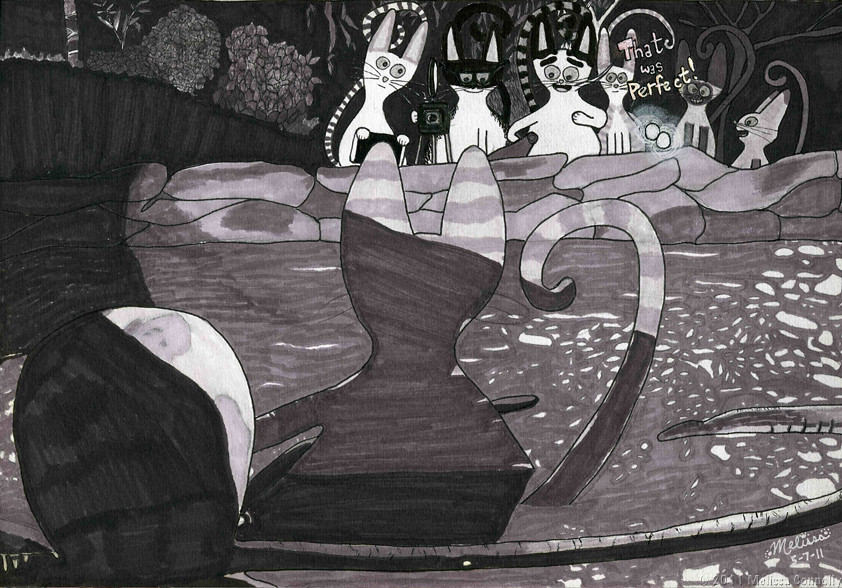
The Kitties will do anything to get this one made!
The Kitties were all for the Ed Wood homage in black and white. We had to choose a filming scene because that's what Ed loved best. Here is one of his great moments: Ed (Gordon) dragged the crew (including Norman, Simon, and Comet) out at 3 a.m. to steal an octopus prop from a nearby studio. Now, he's plopping Bela (B.J.) in the middle of it all to stage a big fight. This will match up perfectly with the big underwater finish Ed has planned for his latest movie. Who cares that they forgot to get the octopus motor or that Bela isn't quite underwater? This is perfect! (And only 25 more scenes to go tonight.) 

Johnny Kitties: Celebrating Johnny Depp Film #10--Ed Wood (5-7-11)

What came next?
After this, Johnny traded in his angora sweater for a mask to play the world's greatest lover, Don Juan DeMarco. Check out the Johnny Kitties page to see my review of Don Juan DeMarco and Johnny's other films.  

Sunday, November 28, 2021

Celebrating Stephen Sondheim

 Hi everyone,

I know it's been a long time! I'm slowly making big plans for Melissa's Kitties with a new look coming soon in 2022. Please stay tuned...

In the meantime, let's take a moment to celebrate Stephen Sondheim, who passed away this weekend. I grew up watching West Side Story, and Tim Burton's Sweeney Todd is one of my all-time favorite films. 

Stephen Sondheim lived a long, fulfilled life, creating hundreds of amazing lyrics for us to enjoy. Yet, I know the void he left will never fully disappear. There will never be another Stephen Sondheim.

A few years ago, the Kitties performed some unforgettable moments of Sweeney Todd and Into the Woods. Like any Sondheim-related effort, it was hard work that burst off the page! You can check out the film versions of these works on streaming services or DVD. 

First, Gordon embodied Sweeney Todd, out of jail after being convicted on a false charge by a corrupt judge and ready for revenge. 

And, then, for something completely different: Gordon played the Wolf, charming Mini as Little Red Riding Hood when she ventures Into the Woods on the way to Granny's house.

We haven't yet tackled West Side Story, but we will. Did you know that classic film is celebrating its 60th anniversary this year? Thanks to Turner Classic Movies, you can catch it in theaters across the country today or Wednesday. I'm heading out to see it on the big screen this afternoon. Are you? (Come on, treat yourself! You'll be glad you did.)  

I last saw Stephen Sondheim recently on The Late Show with Stephen Colbert, where they discussed Steven Spielberg's new version of West Side Story, which hits theaters December 10. He assured us, "It's fantastic!" I don't doubt it and can't wait to see it. Mark your calendars! 

Above all else, when checking out any of his work, sing along, tip your glass or throw your shoe in thanks to Mr. Sondheim for his glorious words and music. They'll live forever. 

Friday, July 09, 2021

Johnny Kitties Celebrating Johnny Depp Film #59. City of Lies (2021)

[What is Johnny Kitties? See Johnny Kitties: Celebrating Johnny Depp for all the details. Visit the Johnny Kitties page for a full list of Johnny Depp's filmography and links to all previous Johnny Kitties blog posts.]

I really only wanted Johnny Depp for this role. I know there was a version of Russ Poole in someone else's hands that was just potentially boring, and uninteresting   and I knew in Johnny's hands, that would never be the case.  Director Brad Furman

This is the guy you want on the case. 

Based on true events, City of Lies presents the intricate unsolved mystery around the murder of rapper Christopher Wallace 
– better known as the Notorious B.I.G. or Biggie Smalls  who was gunned down at a stop light after leaving an event in Las Vegas in 1997, just months after the similar death of rapper Tupac Shakur. Based on the nonfiction book LAbyrinth by Randall Sullivan, this film follows Detective Russell Poole (Johnny Depp) as he seeks and becomes obsessed with the truth – at the cost of his family, health and faith in the Los Angeles Police Department. 

Why is everyone shooting each other? 

City of Lies was a surprise release in 2021 that I found out about from Johnny himself when he publicized it on his Instagram account. (I could get used to this.) The movie was actually ready in 2018 but shelved days before it was supposed to be released. There are many theories why, but none provide a definitive explanation, so I will just take this sudden treat and forget about the drama around it. 

This is a fast-paced, intense movie that presents plenty of theories of its own about the murder of Biggie Smalls. Detective Russell Poole was hot on the trail but hit roadblock after roadblock as he discovered involvement and cover-up activities by several of his fellow police officers in the Los Angeles Police Department. He became so obsessed with cracking the case that he studied it for more than 20 years, until his death in 2019. 

The film was originally called LAbyrinth, after the book on which it's based, because that's what this investigation became. There are so many people involved, it took me a few viewings to track who they all were and why and how they took part. (I'm not sure I fully get it yet, but it doesn't matter.) 

To help us along, Forest Whitaker plays an invented character, Darius "Jack" Jackson, a journalist who reported wrongly on the murder when it happened and is now trying to correct his past mistakes. He seeks out Detective Poole hoping to figure things out together. "Jackson is a made-up character, but he's the kind of made-up character that's necessary because Poole's going through something very serious and very intense, and he's got no one to turn to," Johnny says. 

This is not a spoiler: The murders of Biggie Smalls and Tupac Shakur remain unsolved. Despite the subject matter being more than 20 years old, the topic is extremely relevant today. Director Brad Furman hopes City of Lies will peak enough curiosity to keep the investigation going. 

Was this one worth the wait?

Of course, my answer is yes! 

City of Lies is like a mix of documentary and film noir styles. Director Brad Furman strove to give it a more realistic feel, and I think he succeeds. It starts off with a bang, literally – a case of seemingly unrelated L.A. road rage – and doesn't let up. It's dark, gritty and uses footage of actual news reports and interviews about Christopher Wallace's murder. In fact, his mother Voletta participated in one of the movie's scenes. The director read LAbrynth years ago and wanted to make the movie but wouldn't do so without the approval of both Wallace and Shakur families. He got it. And, with the untimely death of Russell Poole before production began, everyone involved with this film was committed to getting the message and story right for the real families involved. They still seek resolution and peace.


I was also really excited about Johnny and Forest Whitaker working together in City of Lies, so many years after their first movie together, Platoon. Apparently, they were keen about this chance, 32 years later! Most of their scenes were tense, argumentative and confrontational, as they pushed each throughout the investigation. "For me, Jackson is the alter ego of Poole, but mostly the pessimistic side. Mostly, Poole is facing a side of him that he is not and refuses to be, and Jackson is looking at a version of himself that he could never be," Johnny says. "He doesn't have that purity, that belief that you can make a difference – one man." 

These two actors also work differently, as the director explains, "Forest  had a lot of questions and wanted a lot of things from me that Johnny just wasn't asking. They have very different approaches and my hope and goal was that that would create some time of energy on screen that would be exciting for us to watch." The rest of the cast is full of fantastic character actors, who matched their energy and created a fitting murky, volatile atmosphere for them. Two standouts for me are Glen Plummer as Psycho Mike and Rockmond Dunbar as Dreadlocks. (They both have good hair.) 

These days (and, really, always), I love seeing Johnny work without any accent or elaborate costume or disguise. It's in these kinds of roles that his talent as an actor really comes through clearly. Writer Randall Sullivan knows what I'm talking about: "When I watched the film, it really struck me more than it ever has that film actors have to be masters of such subtle expression. I mean, a lot of acting is done with the eyes. Johnny was really able to convey a lot of deep emotion that brought Russ back to me with a pretty stoic – apparently stoic – demeanor." 

Here, Johnny plays an average, good guy whose work has taken over his life. I can see why he connected to this role of someone who will go to extremes to get to the truth. As the director explains, "I felt, in getting to know Johnny, there was a real innocence....He's a big believer in just truth and justice, simplicity. And, when you take all that, and you understand that he looks at it through this innocent lens, I felt that the role of Russell Poole fit just like a glove...I believe Johnny felt a real deep connection to the material and his fight for truth and justice. That was something we talked a lot about on Day 1." 

True to form, Johnny did exhaustive research and met with the director for hours that day, during which they connected on everything from the book and character to life and music, in general. As usual, he added his own personal touches, including friends Joe Perry on the soundtrack and activist Killer Mike in a scene. 

Russell Poole steadfastly believed in the Homicide Investigator's Creed, which he taped to his desk: "No greater honor will ever be bestowed on an officer than when he is entrusted with the investigation of the death of a human being. It is his duty to find the facts regardless of color and creed." After being shut out by his fellow officers during the investigation, he quit weeks before his retirement, but continued the work on his own. He lost his family over his obsession with the truth and worked at it until the day he died. "It's shocking that the truth can actually be buried if a couple of powerful institutions want to collaborate to do it, but it leaves the people who know the truth in an unbearable situation because they can't unknow that truth," Writer Randall Sullivan says. "To live with the fact that it's being buried, in Russel Poole's case, it just sort of killed him day by day."

The Kitties are on the case now. 

In this movie, I loved watching Forest Whitaker and Johnny in their tense scenes and how thoroughly Russell Poole worked to put the pieces together to solve his case. Here, our Kitties, Walter and Gordon, depict one of their fights, an argument that questions Detective Poole's integrity. That's not the right thing to question because you can see how his apartment was consumed by his work everywhere you look. He was connecting the dots all over the walls.

What's next? 

I'm still waiting to see Johnny as war photographer W. Eugene Smith in Minamata, which was supposed to be released last February 5 but wasn't. Is this some strange new Hollywood publicity tactic? It's okay. I'm game for another surprise movie treat. Minamata won't be any happier than City of Lies, but I'll be happy to see it whenever it shows up. Stay tuned.... 

Wednesday, December 09, 2020

Johnny Kitties: Celebrating Johnny Depp Film #58. Waiting for the Barbarians (2019)

[What is Johnny Kitties? See Johnny Kitties: Celebrating Johnny Depp for all the details. Visit the Johnny Kitties page for a full list of Johnny Depp's filmography and links to all previous Johnny Kitties blog posts.]


"So, to me, Joll is a series of very strong protective walls he's built to ward off feeling, to escape feeling. I mean, what does he do when he's alone? He may weep in a closet. I don't know. To me he seemed like he was ready to pounce on anything that penetrated his armor. I think Joll is, in a sense, a victim on his own." Johnny Depp on Colonel Joll

"He was very charming and across the camera was very present and focused. A lovely person to act with. He brings up a kind of great vulnerability." Mark Rylance on Johnny Depp

Why are we waiting for barbarians?

The daily routines of a magistrate (Mark Rylance) managing an isolated outpost of an unnamed empire is disrupted by a visit from Colonel Joll (Johnny Depp), who demands a report on the current state of affairs amid growing concerns of an impending uprising by the local nomads or — as the colonel refers to them — the barbarians. His cruel interrogation tactics toward them makes the magistrate question his loyalty to the empire over his conscience. Director Ciro Guerra's Waiting for the Barbarians is a thought-provoking film based on the 1980 novel, written and adapted by Nobel laureate J.M. Coetzee. 

I haven't read this novel, but both Johnny and Mark Rylance immediately connected to the story's relevance. "The shocking thing for me, which was the beacon that stayed there, was the fact that it felt all true and relevant to today in many ways in a lot of different places in the world," Johnny explains. "Power begets power, and there are those who decide who follows or who is disposable or unnecessary, and all those decisions are made by the people at the top." Mark Rylance adds, "The way the novel can be extrapolated to almost any circumstance in the world, to any point in history, is staggering." 

Who are the real barbarians here? 
Because of the pandemic, Waiting for the Barbarians was released to streaming services, and I ended up watching it at my desk on my iMac.
 I prefer a trip to a movie theater for the big screen, but it was nice to be able to prepare my own snacks (hot chocolate and strawberries) and click play on YouTube whenever I was ready. 

I was afraid to watch this movie because I already unintentionally saw headlines of mixed reviews that praised Johnny's terrifying performance. But that didn't stop me. Not only did I watch it, but I liked it! Of course, I prefer no cruelty or torture, but as a whole, I liked the look and feel of everything else in this film. Beautifully shot by cinematographer Chris Menges, it's got a meditative, slow pace and a great soundtrack by Giampiero Ambrosi to match.

The movie opens to this pulsating beat in an expansive desert, following a lone carriage surrounded by soldiers on  horseback.  Colonel Joll, a member of the police from the Bureau of State Security, has arrived at this random outpost to question the magistrate and locals about the current state of affairs. 

Johnny is sinister and stoic with a steadfast frown here: He has always been great at expressing everything with a look rather than a word, and this performance is a good example. He does have some great lines, but mostly, he instills fear by just looking official and menacing. With a nod or other minor gesture, he can get his underlings to spring into action. 

"I find the most interesting thing about bad guys throughout history, or characters like Joll, is that people don't wake up in the morning and decide while they are shaving: 'I'm going to be the meanest or worst human being. I'm going to cause as much havoc as possible,'" Johnny explains. "No, for me, playing Joll, he seemed very different to me than a bad guy. That felt like it would have been too easy. If you try to think about how a man like that is built, how he is turned, how a man like this arrives at that place: Is it really to be without emotion; is it sociopathy or psychopathy? Or is there somewhere in that guy that harbors a broken child in there or that has been hammered into a shape by his father or mother in his upbringing?"

Colonel Joll is a stark contrast to the magistrate, wonderfully portrayed by Mark Rylance. This quiet, thoughtful observer is kind, gentle and respectful toward the natives. Having witnessed the unnecessary pain and suffering that Colonel Joll inflicts on the locals without any real cause, you see the magistrate's frustration grow. The Colonel's explanation — "Pain is truth; all else is subject to doubt." — just doesn't cut it. As Colonel Joll's crew disturbs the peace and leaves the outpost in ruins, the magistrate's loyalty sides with the locals. It's a good thing, too, because these nomads will eventually get it together. 

I like that there's so little action in this movie that it's hard for me to describe. For example, one scene shows the magistrate falling asleep after hours of washing a local woman's injured feet with warm water. Watching this movie, I could focus on and see what the characters were thinking. How often does that happen?

The Kitties will put a stop to any barbaric behavior.

The best part of Colonel Joll is his cool shades. Johnny describes them: "When Ciro came up with the shape, they were threatening, menacing, somehow; and the fact that he wouldn't take them off, he would make the magistrate as uncomfortable as possible. He learnt some tricks over the years. Calmness, stillness and quiet, and holding your response to a question can be quite disturbing to the person on the other side of you. They are levels of maintaining the armor." 

Check out this sketch by production designer/set decorator Crispain Sallis. "Through that characterization, [Johnny] cut Colonel Joll back to the absolute bone, making any additional theatrical flourishes, such as the glasses or the swagger stick, things to absolutely relish," he explains. 

In my own illustration, I'm not sure the shades come across quite as menacing, but Colonel Joll (Gordon) also accessorizes his uniform with a golden hammer that he considers using to beat up the next barbarian. (Did I mention he's not a nice guy?) This is the only moment where Colonel Joll manages a slight smirk, pleased with the fear-induced power he has over these nomads. When the magistrate (Comet) speaks up, pointing out his evil ways, Colonel Joll's face and stance stiffen and his frown returns. Don't worry, Comet didn't get hurt in the making of this illustration. (Also, I realized after I finished this drawing that the uniforms are a deep navy color — not black — but it all depends on the sunlight, right?)

Check out this Crock of Gold!
In other exciting Johnny news, be sure to catch Crock of Gold: A Few Rounds with Shane MacGowan, a documentary that Johnny produced about his friend and frontman of the Pogues. It is available now in the United States and Canada for viewing on home digital platforms and DVD. Additional worldwide releases are coming later this month. I am getting ready to watch it with the volume up. 

What's next? 
Look at me, all caught up with Johnny Kitties! Mark your calendars for February 5 to see Johnny as war photographer W. Eugene Smith in Minamata. I am pacing the floors for this one. 

All photos © Samuel Goldwin Films, except the glasses sketch, courtesy of Crispain Sallis, and the Crock of Gold poster, courtesy of Magnolia Pictures. 

Wednesday, November 11, 2020

Johnny Kitties: Celebrating Johnny Depp Film #57. The Professor (2018)

[What is Johnny Kitties? See Johnny Kitties: Celebrating Johnny Depp for all the details. Visit the Johnny Kitties page for a full list of Johnny Depp's filmography and links to all previous Johnny Kitties blog posts.]

"The Professor is a quirky comedy of sorts – stark, enchanting, funny, tragic. It's rare to see comedies that tackle the subject of death." Danny Houston

"Accepting one's mortality and the fact that we're going to die shouldn't be a depressing thing." Wayne Roberts

"May we forever remember that in each and every moment, we are composing the stories of our lives. Let's aim to make it a meaningful read or at least an interesting one." Richard Brown (Johnny Depp)


Life is what you make of it. 

After learning that he has terminal lung cancer and maybe six months to live, Professor Richard Brown (Johnny Depp) realizes that he has no time to waste and spends the rest of it teaching his last students to say what they mean, live however they want, and make the most out of life. Taking his own advice, Richard speaks without a filter, indulges in his whims, and creates his own path toward the exit. Through The Professor, writer/director Wayne Roberts poses tough questions and makes bold statements to remind us that death is an important part of life.

The Professor got a failing grade. 

Typically, I don't look for or read movie reviews before I see them – especially for movies I'm looking forward to seeing. Reviews affect my own opinions: Once I read them, I can't forget what was said while I'm watching the movie. In the case of The Professor, the reviews found me and most of them were bad. The sentiment was so universal that the movie was never properly released in theaters in the United States. Instead, it went straight to DVD in 2019. 

I only read a couple of these bad reviews before I decided to deduce the opinions from just the headlines. Some reviewers made the unfair comparison of Richard's behavior to Johnny's own, so I stopped reading and waited to see this thing for myself. 

I see what they mean, but...

Maybe it was because of the reviews, but I didn't like The Professor at first. He and his wife are so mean to each other. He is bad at his job and doesn't care. He's a bad influence on his students. He's making bad choices. Is this really what people think Johnny is doing in his own life? How dismal. 

What I find so jarring is that Richard's choices of how to spend the rest of his days are so different from what I would think to do, but that's probably the point. Anyone who finds out that they are going to die soon probably assumes that they should do whatever they feel like doing in the moment. In Richard's case, that includes drugs, infidelity, and a bender in the middle of the week. 

...The Professor has some good points.

I warmed up to The Professor because there are also moments of reflection, clarity and purpose. In fact, it made me cry by the end, which has got to mean something. 

Like most Johnny movies, The Professor has a great beginning. In the opening scene, Richard is in the doctor's office getting the bad news – a terminal diagnosis and only a few months to live. For the next few minutes that span the rest of his day, the news sinks in and Richard is lost in thought about what it means. Johnny is so good at saying so much without saying anything, but Richard shares his distress and anger every once in a while with a single repeated curse word, expressed in a variety of ways. It's both funny and sad.

I also love the elements that glue this movie together – the structure and soundtrack, the cinematography and scenery, and the script and cast. 

  • The Professor is divided into chapters that reflect Richard's thought process: For example, Chapter 1 is I Have Something To Say and Chapter 3 is I'm Really Going to Die. I like how these titles set the tone for the next scenes. 
  • Also setting the tone is a great soundtrack that includes refreshing classical and comforting Motown. 
  • Filmed in Vancouver, The Professor is full of beautiful shots, highlighting impressive architecture, sets, and scenery that makes me want to plan a vacation there. Given the grim start and Richard's resulting irreverence, I appreciate having something pretty to look at. 
  • Unorthodox behavior aside, Richard offers plenty of worthwhile lessons about not letting life pass by unnoticed. 
  • This great cast, including Rosemarie DeWitt, Danny Houston, Odessa Young, and Zoey Deutch, seem wholly invested in capturing the balance between life and death, and it's clear that they are having fun doing it. "Johnny's just so alive and present and real in every moment," says Devon Terrell (who plays student Danny). "It's so brilliant to be in a scene with someone who is so kind of almost animalistic in a way that something's going to happen in every moment. You just didn't know what."

I love seeing the relationship between Richard and his best friend Peter (Danny Houston). Danny Houston's performance is my favorite in this movie, maybe because I would likely react the same way to the news of a friend's (or Johnny's) impending death. Apparently, the feeling was mutual: "My experience with Johnny was love at first sight," Danny Houston says. "I don't know if we're playing into what's required for the characters of the piece or whether it's truly heartfelt, but at the moment, it feels absolutely real." I also related to Richard's bond with his daughter Olivia (Odessa Young). In the end, their goodbye is what brought me to tears. (The original title of this movie was Richard Says Goodbye, which makes more sense to me.) 

I'm not sure The Professor deserves all the bad reviews it got. Sometimes, it lays it on thick that life should not be wasted, but is that such a bad message? The humor might be lost on some people because of the seriousness of this subject, but I appreciate the attempt to take the sting out of death. The Professor suggests that we should not be afraid of death but let it help us focus on a well-lived life, there is no time like the present to make changes and do what we need to do, and when the time comes, we should go out however we want. These are themes Johnny has always seemed to live by, so I'm not surprised that he connected to this character. This story may have struck close to home too: The Professor is dedicated to Johnny's mom, who died of lung cancer in 2016.  

The Kitties get it. 

When thinking of how The Kitties could represent The Professor, one scene kept coming back to me. Most of the movie shows Richard indulging in his vices, telling people what he really thinks, imparting words of wisdom to his students, or saying goodbye to those he loves. But in this scene, Richard is alone, dealing with his own thoughts and pain. Maybe I'm reading too much into this moment, but it seems like Richard is realizing that this is really happening, that it's out of his control, and it's something bigger than everything else. He looks up toward the sky, as church bells toll in the background, and it cuts to Chapter 4, titled, It's Really Starting to Kick In. Maybe I'm not too far off. 

I was also struck by the interesting stark angles and textures in this shot of someone huddled in a space with jagged rock, aged wood, and hard tile. It's an uncomfortable but pretty space. 

What's next? 

In Waiting for the Barbarians, Johnny plays a colonel who doesn't have to say much to instill fear in innocent people, waving his misguided authority around with a fancy golden hammer. 

All film images © Global Road Entertainment; illustration © Melissa Connolly