Saturday, July 09, 2011

Johnny Kitties: Celebrating Johnny Depp Film #10 – Ed Wood (1994)

[What is Johnny Kitties? See Johnny Kitties: Celebrating Johnny Depp for all the details.]

"This is it! This is the one I'll be remembered for!"
Despite my involvement, this movie is a tender, comic gem. An amazing cast to work alongside in Martin Landau, Bill Murray, et al., but, of course, with Tim, there exists an almost brotherly sensibility, which made the whole experience a joy. Ultimately, I feel, with the artistic freedom we had, TB produced an American classic. A love letter to a filmmaker that didn't receive many. 
– Johnny Depp

After his death in 1978, Ed Wood became best known as the world's worst film director and a cult following was born. Among his biggest fans were Tim Burton and Johnny Depp. 

"This is Edward D. Wood, Jr." 
The real Ed Wood
Ed Wood's most famous features are the autobiographical Glen or Glenda, which explores a transvestite's struggle for a normal life, and Plan 9 from Outer Space, a science fiction/horror movie that was funded by local Baptist churches and completed in 5 days. Unlike your typical director, who may take all day to shoot one scene and finish a film in months, Ed Wood might have shot 30 scenes in a single day. Usually without permits, he had to steal shots whenever and as quickly as possible. His films weren't your typical Hollywood blockbusters; they were Ed Wood opuses. As scriptwriter Larry Karaszewski explained, "There's a personality to Ed Wood films that you don't necessarily get in a lot of other people's films. A lot of bad films are simply bad movies or incompetently put together. With Ed, you get a real sense of the filmmaker behind the camera. You see an Ed Wood movie, and you know it's an Ed Wood movie because of the obsessions and the fetishes. The stuff he's throwing up on the screen is clearly his way of working something out inside of him." 

In Ed Wood's eyes, every film he made would be the one to make it big. Scriptwriter Scott Alexander noted, "Where Ed's movies are distinctive is that there's such passion there. The passion is oftentimes misguided, but it's there." That's where Tim Burton's film takes flight. 

Ed Wood focuses on the director's friendship with aging Bela Lugosi (Martin Landau), who had fallen from stardom after portraying "Dracula" during the Silent Era and was now battling drug addiction and poverty. After a chance meeting, Ed (Johnny Depp) wanted to help Bela–one of his childhood heroes–by giving him parts in his films. The friendship lasted until Bela's death 5 years later. 

"Let's Shoot This F#*%@r!"
When Tim Burton received this bio-pic's script, co-written by Scott Alexander and Larry Karaszewski, he dropped his other projects and got to work, hardly changing anything on the page. He remembered, "It's probably the first time ever that I got a script and said, 'Yeah, let's shoot this.'"

Studying Ed Wood's original letters, Tim and Johnny got a sense of an unwavering upbeat optimism about his work. Because of that, Johnny's performance is hilariously enthusiastic and joyful. His other ingredients for the character of Ed Wood included the heart of The Wizard of Oz's Tin Man, the blind optimism of Ronald Reagan, and the distinctive voice of Casey Kasem. Working with Tim again on a project that became a labor of love for all involved was just what Johnny needed to break out of the, let's say, dark place he was stuck in while filming What's Eating Gilbert Grape? "Ed was the rocket ship that took me away from that horrible, black, bleak time," he said. "This guy needed to be the ultimate optimist, dreamer, idealist. It was like being in a completely different suit or skin. It felt very good." His friend, Director Jim Jarmusch can attest: "I was staying at his house for a while when he was shooting Ed Wood, and sometimes I would pick him up from the set and we'd get dinner. It would take him three hours to stop being 'Ed Wood'. I just wanted to slap him to get that stupid smile off his face. We'd be in this Thai restaurant and Johnny is going, 'Hey, this Pad Thai is fabulous!'"

Johnny's performance fits perfectly into Tim Burton's version of an Ed Wood film – beautifully stylized in black and white with all the perceived normalcy of the 1950s. "You're mixing different elements," Tim explained. "You want to get the flavor of an Ed Wood movie without being an Ed Wood exactly." 

"This is perfect!" 
Tim Burton's Ed Wood is one of his best. It's one of Johnny's best. It's one of the world's best! They made a movie that struck a bittersweet balance between Ed Wood's rosy vision and reality. It is at once hilarious, heartwarming, heartbreaking, and joyful. 

This movie is about the love of filmmaking. In his review, Roger Ebert proclaimed that every film school in the country should show this film to their students to instill the devotion to and joy of the work. No matter what happens, everything is perfect in Ed's eyes. His love of producing and directing –  getting the film in the can – was all that mattered. 

The writers noted that there were several more scenes reflecting Ed's insecurities and self-doubt, but they didn't make it into the film. Larry Karaszewski explained, "Johnny and Tim grew to love Ed so much that it made them uncomfortable to give  Ed those moments." 

At the heart of this movie is friendship and acceptance. No one in Ed Wood's circle is "normal," yet by the end of the film, you are cheering for all of them. Aside from Bela Lugosi and himself, Ed Wood's cast often included Swedish wrestler Tor Johnson (George "The Animal" Steele), ghoulish TV hostess Vampira (Lisa Marie), self-proclaimed psychic Criswell (Jeffrey Jones), and drag queen Bunny Breckenridge (Bill Murray). The "bad guys" in this movie were those embarrassed by Ed's love for cross-dressing or confused by his films' lack of continuity or retakes. But this troupe of misfits stuck together like family. And that was no clearer than in the relationship between Ed Wood and Bela Lugosi. 

Martin Landau as Bela, consulting with his director.
Brilliantly played by Martin Landau, becoming Bela Lugosi was a challenge: "What you've got here is a 74-year-old Hungarian morphine addict/alcoholic who has mood swings," Martin explained. "That would be hard enough, but it had to be Bela Lugosi, who everyone knows!"  Paying homage to the actor, Martin considered this film a male love story, one between two guys who really needed and depended on each other. "You could tell that between Martin and Johnny there was a real respect and a kind of bonding that went on with them because they were both good at a certain level," Tim said. "It was exciting to see that."  

"We have to go see Ed Wood!" 

I had no idea who Ed Wood was at the time I saw this movie, and I don't remember how or where my family and I went to see the film. But I do remember two things: 1) There was no question that we were going to see it this time – no convincing, plotting, or pleading necessary, and 2) While watching the movie for the first time, I was worried about what my parents thought while Johnny strutted around in drag doing a strip tease among his friends in a meat packing plant. On the other hand, I was thrilled by Johnny's fearlessness to do whatever – and for Johnny, "whatever" usually guarantees the unexpected. It's a trait that remains in full force today, and one of the reasons I will always see his movies. Tim agrees, as he discussed being able to work with Johnny again on this project: "'Edward Scissorhands' was a character who didn't speak, and now we're dealing with a character that won't shut up. It's great to see an actor go from one thing to something completely different. There's a great energy to seeing something like that. He's just so willing to do anything that way. In fact, he usually wants to go farther than you want him to go. It's nice for other actors to see." The reviews everywhere for Tim Burton's little film were positive, even those from my own family.

Ed Wood was nominated for too many awards to list here. Among them were Johnny's third Golden Globe nomination and his win for Actor of the Year from the London Film Critics. Ed Wood earned two Oscars – one for Martin Landau's amazing performance and one for the makeup team who transformed him into Bela Lugosi.

Because of this movie, I sought out Ed Wood's own films, which I so much wanted to love as much as Tim, Johnny, and company did. But I just couldn't do it. They actually made me sad. I felt better once I found out that the writers are aware of this phenomenon: "What's interesting is that when you watch our movie, and then watch Ed Wood's films, our movie affects the Ed Wood films themselves," writer Larry Karaszewski said. "It's much harder to laugh at Ed Wood films, particularly Glen or Glenda. It feels like a piece of personal filmmaking, where you feel like this guy is putting his soul onto film." It's true: Watching the real Ed Wood movies, I was excited to see all the real people who were portrayed in Tim's Ed Wood, and I was still rooting for them to do well. I probably always will. 

Check it out: Once you see Ed Wood – and you should all see it – it'll happen to you too. This labor of love is contagious.

The Kitties will do anything to get this one made!
The Kitties were all for the Ed Wood homage in black and white. We had to choose a filming scene because that's what Ed loved best. Here is one of his great moments: Ed (Gordon) dragged the crew (including Norman, Simon, and Comet) out at 3 a.m. to steal an octopus prop from a nearby studio. Now, he's plopping Bela (B.J.) in the middle of it all to stage a big fight. This will match up perfectly with the big underwater finish Ed has planned for his latest movie. Who cares that they forgot to get the octopus motor or that Bela isn't quite underwater? This is perfect! (And only 25 more scenes to go tonight.) 
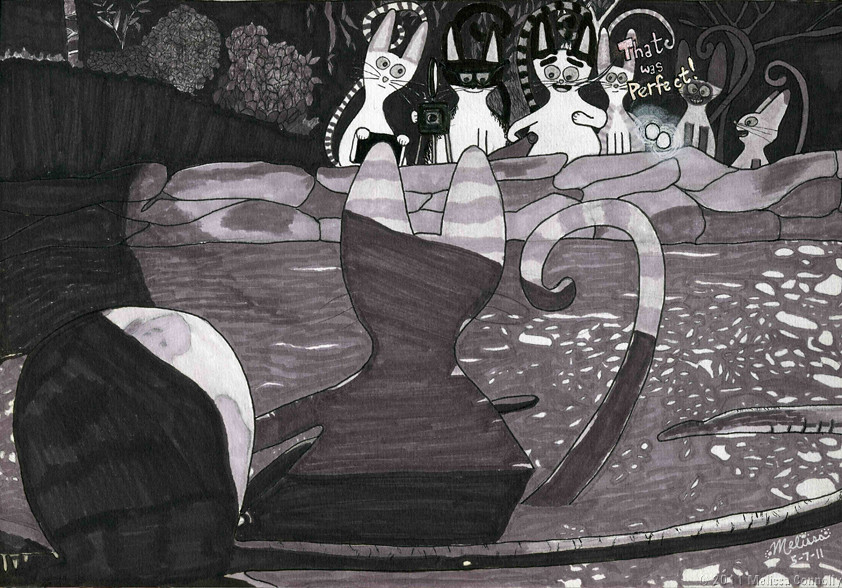
Johnny Kitties: Celebrating Johnny Depp Film #10--Ed Wood (5-7-11)

What's next?
Johnny trades in his angora sweater for a mask. Next month, we'll meet the world's greatest lover, Don Juan DeMarco.


All photos © Touchstone Pictures, except Ed Wood portrait, courtesy of Wikipedia.

Monday, July 04, 2011

Remedy

This week's Illustration Friday topic brought to mind several remedies--medicine for allergies, yoga for stress, naps when overtired. But, no matter what my nagging complaint, my most trusted remedy is Lily Cat.

Remedy (July 1, 2011)
(Illustration Friday: July 1, 2011)

Tuesday, June 28, 2011

Midsummer Night

I looked up Midsummer Night in the dictionary and on Wikipedia because all I knew about it was Shakespeare's Midsummer Night's Dream, which I've never read or seen.

I found that worldwide celebrations mark the summer solstice on Midsummer Day--sometime between June 21 and 24, depending on the culture.  Traditionally, it was believed that witches and other supernatural beings took over the night before--Midsummer Eve--causing widespread mischief.

While all that was going on around the world, The Mother Kitty enjoyed a quiet moment during her evening walk.

Here is her Midsummer Night.

Midsummer Night (June 24, 2011)
(Illustration Friday: June 24, 2011)

Wednesday, June 22, 2011

Launch

When Lily is ready to jump from any high surface, she always makes an official launch.

Launch (June 17, 2011)
(Illustration Friday: June 17, 2011)


Wednesday, June 15, 2011

Swept

The Kitties and I are thrilled about the start of the new season of "So You Think You Can Dance." To celebrate, The Kitties pay tribute, here, to one of our favorite dances from last week's opening show. Choreographed by past contestant Travis Wall, the joy of this dance swept us all away.

Swept (June 10, 2011)
(Illustration Friday: June 10, 2011)

Here is the dance performed by the final five contestants to be selected for the competition: Ryan [Lily], Mitchell [B.J.], Ashley [Ashes], Alexander [Gordon] and Caitlynn [Mini]:

© Fox Broadcasting Company

Thursday, June 09, 2011

Johnny Kitties: Celebrating Johnny Depp Film #9--What's Eating Gilbert Grape? (1993)

Happy Birthday, Johnny!!!
Pirates of the Caribbean: On Stranger Tides Moscow premiere
Are you singing, eating cake, watching a Johnny Movie? 
Find a way to toast Johnny Depp today on his 48th birthday!  

Can you believe it's been a year since I started Johnny Kitties?  And I'm still in the '90s! The Kitties and I are having a fantastic time chugging along Johnny's filmography. Some drawings have been quick; some have taken weeks. (It's a good thing that this is only a once-a-month treat!) But what's the difference when it's a labor of love?

Speaking of love, what are the odds that my all-time favorite Johnny Movie would be posted on Johnny's birthday? I don't know what it means, but it's got to be more than a coincidence, don't you think? 

Let's get to it!

Who is Gilbert Grape?
Because he had already read the wonderful book by Peter Hedges, Johnny Depp agreed to star in What's Eating Gilbert Grape? before the script was written.  "If Johnny had not said, 'I'll do it,' without a script, I don't think the movie would have happened," Hedges says. That would have been tragic! 

Family portrait: Becky and the Grapes
© Paramount
What's Eating Gilbert Grape? chronicles a year in the life of Gilbert (Johnny Depp) in Endora, Iowa. Nothing much happens in Endora. It's the type of town you pass through, but Gilbert is tied to it in a life consumed by family responsibilities. He lives with his two sisters, his mentally challenged brother, and his morbidly obese mother, who hasn't left the house in years. Gilbert spends most of his time taking care of his 18-year-old brother Arnie (Leonardo DiCaprio), who has the mind of a 5-year-old and who doctors warn "could go at anytime." Gilbert's routines consist of working at the local grocery store, carrying on an affair with Mrs. Betty Carver (Mary Steenburgen), and having mundane conversations with his two buddies Tucker and Bobby (John C. Reilly and Cripin Glover) at the town diner. 

Every year, Arnie and Gilbert wave to the annual parade of trailers that drive through town on their way to more interesting places. When one breaks down, Becky (Juliette Lewis) and her grandmother see Endora in a different light while waiting for their trailer to be fixed. Meeting the stranded strangers changes Gilbert's life, helping him see things a little differently too.

The One that Captured my Heart
By now, my parents realized that my loyalty to Johnny Depp was not dwindling. I was really excited that Johnny signed on for this movie because I admired the director, Lasse Hallstrom, whose great award-winning Swedish film, My Life as a Dog, I had somehow recently seen. To my great surprise, Dad suggested that we take the 90-minute drive to an artsy theater in Cleveland, the only theater in the vicinity showing What's Eating Gilbert Grape? Part of the deal was to stop by my dad's friends' house in Broadview Heights beforehand. They were happily surprised to see us, and shortly after our arrival, dad explained what brought on this sudden visit. Here's how that went:
Dad: "Well, do you know Johnny Depp? 
Friends: "Yes." 
Dad: "Well, Melissa is deeply in love with him."
Me: "Daaaaaaaad!!!!!"
Dad: "What?" 
I don't remember the rest of that conversation. Maybe I fainted. 

For the longest time, I referred to What's Eating Gilbert Grape? as The Best Johnny Movie Ever. Some newer Johnny Movies may have assumed that title for a while, but this remains in my heart as The One. I can't really articulate why I love it so much: Granted, I gravitate toward quiet, character-driven films. And, at the time, I lived in a town similar to Endora and understood Gilbert's frustrations of being stuck in the monotony. But I think Lasse Hallstrom put it best: "This film was a wonderful coincidence of the right people getting together with the right story at the right moment. I was very lucky for that." (Yes, we all are!)

Gilbert and Arnie give Becky a ride home.
© Paramount
Endora and its citizens are completely believable and recognizable. With a stellar cast, the acting is so natural that you can't help but think it's all real. In Endora, the big news is the impending arrival of Burger Barn, a fast food franchise. "They are cutting edge," Gilbert's friend Tucker says. "They use Canola oil! I bet you don't even know what that is!" Bobby runs the local funeral parlor with his father. When Gilbert asks him how business is going, he responds, "Not good. No one is dying." No wonder Becky, with her fresh perspective, is just who Gilbert needs. 
    
When this film was released, two of its stars got all the press. There's no doubt that Leonardo DiCaprio deserved all the praise, awards, and Oscar nomination he received for his genius performance as Arnie. And, after being spotted on Sally Jesse Rafael's talk show discussing obesity, Darlene Cates scored the role of Mama, winning the hearts of audiences--and everyone around her--because of her remarkable spirit and bravery. She turned out to be a true natural. But I have to commend Johnny for his performance. So far, he had been playing film characters labeled "oddballs," "outsiders," and--Ugh!--"quirky." Some might consider Gilbert another outsider, but to me he's an ordinary guy stuck in extraordinary circumstances. Everything is internal with Gilbert, and Johnny's talent for saying everything with his eyes is on brilliant display. Writer Peter Hedges agrees: "In some ways it's the harder performance, particularly since, in the novel, he gets all the thoughts," he says. "There's so much life going on in his performance. I don't think there are very many actors who could have come close to what he did." 

© Paramount
Every time I watch this movie--and I've seen it many, many times--I feel the same amount of emotion as the first time, and I find something different to love about it with each viewing.  Johnny feels differently: Once, he caught What's Eating Gilbert Grape? on TV and had to quickly change the station when he realized he began hyperventilating. He says of the filming experience, "I don't know if it was coincidental that I was going through this emotional turmoil or if it was something that, maybe--on some weird level--I had done to myself subconsciously because of what was required. But, anyway, I was kind of miserable at the time, and it's pretty plain to see." 

Johnny modeled Gilbert after his childhood friend, Bones, which accounts for the red hair and crooked teeth. But I always felt that this character was very close to who Johnny really is. Maybe Johnny, helping to take care of his own mom while growing up in a small town with sights of a brighter future, understood Gilbert's frustrations a little too well. I could find a few parallels from his life but don't want to speculate about what only Johnny knows. What connected with me was that Gilbert was always trying to do the right thing, putting everyone else first and forgetting about himself. When Becky asks him what he wants, his response benefits only his relatives--until she interrupts,"What do you want for you, just for you?"
"I want to be a good person," he says, an improvised line that says it all.

The Kitties visit Endora.
Watching this film recently for Johnny Kitties, the latest ingredient I've come to love about What's Eating Gilbert Grape? is the amazing cinematography. Swedish cinematographer Sven Nykvist is a pioneer of the art who worked consistently with Igmar Bergman. "I loved the reverence that he inspired in people on the set," Peter Hedges remembers. "Everyone knew that they were in the presence of a master." 

Deciding on and drawing a tribute worthy of What's Eating Gilbert Grape? was daunting: At first, I considered my favorite scene, Gilbert's first kiss with Becky. But Gordon and Ashes looked at each other and laughed. Next, I thought of the water tower scene, and Simon got very excited about the thought of climbing to the top. I ruled that out because of safety concerns. While the water tower scene is probably the most recognizable image from the movie, I prefer the quiet moments that make this film a gem. Since I couldn't just draw a picture of Gordon staring at something, I picked a scene at the lake. 

True, this was a night scene, but it was filmed during the day and then darkened on film (by the master). Since the scene was so dark, I had to create some of my own background; then I just decided to make it lighter because what if you couldn't see it either? Chalk it up to artistic license.

Johnny Kitties--Celebrating Johnny Depp--What's Eating Gilbert Grape ([April 9, 2011]

Following a frightening fight with Arnie, Gilbert runs out of the house to escape what he'd done. He eventually ends up near Becky's trailer and finds her in the lake. She's coaxing Arnie, who hadn't bathed for days after having a scare with water, to join her for a swim. For a moment, Gilbert manages a flicker of a smile. Maybe he's seeing what the next chapter in his life could be like. 

Did I mention I love this movie?

What can follow Gilbert Grape? 
Something completely different, of course: Johnny gets in a good mood, channeling Edward D. Wood, Jr.  

Tuesday, June 07, 2011

Shadows

Shadows (June 3, 2011)
(Illustration Friday: June 3, 2011)

Lily's obsession with light and shadows is sort of my fault--mine, and the street lamp's outside.

Wednesday, June 01, 2011

Asleep

I wish I were disciplined enough to sit at a desk when creating my artwork. Typically, I'm sitting on my chaise lounge in front of the TV, surrounded by packs of pens and markers and hunched over the sketchbook on my lap. 

When I draw, I tend to lose track of time--and Lily. When I think of it, I whip my head up to scan the room for her. Here is where I find her most often: across from me--almost always upside down--in her spot on the couch, with her Wubba always nearby. (I think she, too, has lost track of time.)

Asleep (May 27, 2011)
(Illustration Friday: May 27, 2011)

Friday, May 27, 2011

Soaked

Soaked (May 20, 2011)
(Illustration Friday: May 20, 2011) 
It looks like Comet's found the perfect spot under a sunny window. 

This illustration was inspired by some photographs I took of Comet at my sister's house.

Comet in the Sun

They aren't quite the same.

Sunday, May 15, 2011

Safari

Safari (May 13, 2011)

  (Illustration Friday: May 13, 2011)

While on safari in Zimbabwe, Gordon met many of his distant cousins, the Great Cats.
(He had a special ride.)

Monday, May 09, 2011

Johnny Kitties: Celebrating Johnny Depp Film #8--Benny and Joon (1993)

[What is Johnny Kitties? See Johnny Kitties: Celebrating Johnny Depp for all the details.]


Johnny's a Lemonhead!
Before getting started with this month's tribute film, I need to mention that Johnny starred in another music video called, "It's a Shame about Ray" by the Lemonheads, a band led by his friend Evan Dando. I'm not sure exactly when this video was made, but it was around this time. This video isn't as elaborate as Tom Petty's mini-movie, "Into the Great Wide Open," but it's another good song. Besides, it's always nice to hear from the Lemonheads, and Comet--who just found the video in his MTV archives--would not let me move forward without them. The Kitties are already singing along. Here it is:


Head back to Hollywood. 
© MGM
Benny and Joon is about a mentally ill woman named Juniper Pearl (Mary Stuart Masterson), who has lived with her brother Benny (Aidan Quinn), an auto mechanic, since their parents were killed in a car accident years ago. One night with his buddies, Benny's sister engages in a poker game that gets out of control. Before Benny finds out about it, she loses a bet. In the pot is his friend's "stupid" cousin Sam (Johnny Depp). Reluctantly, Benny honors the wager, and Sam becomes Juniper's new caretaker, replacing the one who had quit that morning.

Sam is a movie fanatic, dresses and does tricks like Buster Keaton, and has all sorts of other eccentric habits. When I first saw this movie, I actually thought that he, too, was mentally ill, but it turns out he's just dyslexic. In this new triangle, Sam and Joon (as he spells it) are pretty much on the same wavelength. Things inevitably get complicated.

It's just a movie!
When this movie came out, commercials seemed to be everywhere, and everyone was calling it the perfect "Date Movie." The label instantly annoyed me. I hadn't seen Benny and Joon in years when I  popped the DVD in for Johnny Kitties. Watching it now, I realize why the label bothers me so much--This movie tackles a serious subject.

They never explain what mental illness Joon has and instead focus mostly on the love story. Although Mary Stuart Masterson studied certain behavioral guidelines, director Jeremiah Chechik was afraid that naming any specific mental illness would bring a completely different dynamic to the film. This is probably true. Getting so specific could go horribly wrong, but I also think not knowing what's wrong with her is a missing element in the film. While Chechik wanted to blur the lines between reality and fantasy, I sometimes find situations too cute without knowing the seriousness behind them: After the last caretaker quits, for example, Benny is forced to run home from work because Joon is causing a traffic jam--wandering in the middle of the street wearing a snorkel mask and waving a ping pong paddle. Sam teaches Joon how to cook grilled cheese sandwiches with an iron, something later used to show how he and Joon will live happily ever after. By the time Joon has a real breakdown, I find it sudden, scary, and jarring.

Despite this unevenness, Benny and Joon is a very sweet film with some wonderful moments and unforgettable lines. The heart of it--and what I love about it--is the relationship among these three people, how they help each other in their own special ways. This focus is probably why the mental illness factor was left out. Benny and Joon are stuck: Benny can't do anything or go anywhere because he's always worried about Joon. Joon can't do anything or go anywhere because Benny is always worried about her. Sam, who needs a little help himself, brings absurdity, strangeness, and joy into that mix. Or, as Chechik puts it, "just the kind of nonsense these two people need."

Johnny channels Buster Keaton.
As a kid growing up in Florida, Johnny was hooked on silent movies, thanks to a TV channel dedicated to the genre. Johnny was already a lifelong fan of the era and Buster Keaton when he signed on for Benny and Joon. "The subtlety of the acting to clue the audience into Sam's character with so little said and so much expressed is a testament to Johnny Depp's work here," Chechik says.


Johnny puts his spin on Charlie Chaplin's Roll Dance.
© MGM
Benny and Joon marked Johnny's most physical role yet. He worked with a circus trainer to learn tricks and Buster Keatonesque flips. "There's only one way to find out if you can throw your feet over your head," Johnny says. "That's by doing it." He also learned Charlie Chaplin's famous "Roll Dance" from The Gold Rush. "The 'Roll Dance' was more difficult than bashing myself around the park, just because it was so specific," he says. Chechik says that Johnny learned much, much more than what fit into the film. (He must be saving all this priceless footage for the Criterion Collection edition of the DVD, right? Right???) He confirms Johnny's preparation: "Johnny and I watched hours and hours and hours of Keaton films at various speed. We really studied these wonderful movies that Buster made, and Johnny was very inspired to really see what he could do with that kind of physical comedy and grace, and I think he did him proud." Johnny was nominated for another Golden Globe for this performance.

Though Johnny's role probably gets the most attention and his costars are wonderful, the supporting cast is solid. You'll find Julianne Moore and William H. Macy, early in their careers, along with Oliver Platt, C.C.H. Pounder, and Dan Hedaya.

Gordon has been practicing too.
The Kitties and I (and probably anyone else who has seen and loves this movie) are all in agreement about the moment to honor in our drawing. Actually, I think the last 10 minutes of Benny and Joon make the whole film worth it. After a psychotic episode, Joon ends up in the hospital and refuses to see anyone, but Sam and Benny work together to find her. Sam helps Benny into the locked ward where Joon is staying so that he can talk with his sister. Then, he finds his own way to catch a glimpse of his girl.

Johnny Kitties--Celebrating Johnny Depp--Benny and Joon (1993) [March 5, 2011]


As luck would have it, hanging off the side of the hospital building is the perfect contraption for Sam to use to reach Joon's window. Inside, Benny (Norman) and Joon (Mini) are discussing Joon's options with her doctor (played by C.C.H. Pounder/Ashes). Amid this serious conversation, Sam sudden appearance--swinging by in slow motion to sweeping orchestral music--is heartwarming comic relief genius.

I should mention that Benny and Joon's musical score by Rachel Portman is so perfectly suited for the film that the few pop songs they stuck in there don't seem necessary. I admit, though, that at the time I was completely obsessed with the Proclaimers' "500 Miles," the song that opens and closes the film. (Oh no--Now, it's in my head again.)

I only wish I could have somehow included Sam's swinging and Joon's reaction to seeing him in the same drawing. Sparked by Sam's surprise, Joon's joy is infectious. And, their hug when she gets discharged from the hospital is another beautiful moment. (That may deserve a third drawing, to complete this warm-and-fuzzy trilogy.) Yeah, the last 10 minutes of this movie are golden. But don't take my word for it: rent it, watch the whole thing, and see for yourself.

What's next?
Johnny gets a little too close to home and the world is introduced to Leonardo DiCaprio. What's Eating Gilbert Grape? Find out next month.

Sunday, May 08, 2011

Beginner

Beginner (May 6, 2011)
(Illustration Friday: May 6, 2011)
When Gordon was a beginner, he struggled to climb into my lap. He got the hang of it pretty quickly.

A Season in Hell and Illuminations

Hi everyone,

Rimbaud at 17
I finally finished Arthur Rimbaud's slim volume of poetry, A Season in Hell and Illuminations. I should have known this wasn't a happy book, considering the first title, but I was hopeful of what the Illuminations might bring when I bought it. Completed in 1873, A Season in Hell is a series of poems in 9 parts that depicts a man's journey through life and into Hell. Illuminations--a collection of 42 poems written sometime between 1871 and 1874--isn't quite as angry, covering several topics, including modernity, nature, travel, and change.

I admit much of this symbolist poetry went over my head, and I didn't bother investigating it as I should have. Because these weeks have been really busy, I instead read this book with several long, unintentional breaks--not giving it the attention it deserves. Because I dragged out reading these 79 pages, I got tired of returning to its dark content.

Having said that, I'm glad to have this book in my library and might return to it someday to study it further. I don't quite agree with Johnny Depp, who said Rimbaud's writing is "the most divine in the history of the world"--maybe because I didn't always understand it. But this work is pretty amazing, only made more so when you discover that Rimbaud was only 19 when he finished it and gave up poetry completely by age 21. The writing is modern and timeless. As I read it, I found I could apply phrases to some events and attitudes of today.

Honestly, though, I found Rimbaud's rebellious life more interesting than his poetry--jailed by 15, adulterer by 17, shot at 18, world traveller as a young man, and dead of cancer at 37. I realized last night that I had already seen a movie about Rimbaud years ago before I knew who he was. The film, called Total Eclipse, stars Leonardo Dicaprio and--from what I remember--made me very uncomfortable.

Still, if you're a Rimbaud fan, this is the book for you. This edition--translated, edited, and introduced by Wyatt Mason--includes not only the English version of these works, but the original French versions, edited drafts, a biography, chronology, maps, and some of Rimbaud's own drawings and original papers.    It's complete!

Here's some French poetry for your Sunday morning. From Illuminations, I admired this poem's bold simplicity:

Departure
Seen enough. Visions confronted in every weather.
Had enough. Urban tumult, by night and day, forever.
Known enough. Life's still-points. --O tumult and Visions!
Departure for fresh affection and noise!

In A Season from Hell and Illuminations, I was struck by the vivid imagery and wording that invoked the senses rather than literal translation. Also from Illuminations, this one transported me to the moors of Wuthering Heights--or maybe just a day at the beach:

Seascape
Chariots of silver and copper--
Prows of silver and steel--
Beat foam--
Stirring stumps of bramble--
Currents from the moor,
And the vast ruts of the tidal ebb
Flow eastward, circularly,
Towards the pillars of the forest--
Towards the pilings of the pier,
Whose corner is struck
By whirlwinds of light.

Happy Sunday, everyone! Don't worry, my next book selection will be more uplifting.

Best,

Friday, May 06, 2011

Lesson

The Kitties were gearing up for an art lesson this week, since I've been immersed in Pikaland Artist Bootcamp. But then we found out that An American in Paris was this week's "Essential Movie" on TCM. Hopelessly devoted to Gene Kelly since I was a kid, I've seen this movie a zillion times. (And I could always go for one more.)

I remembered that during one of my favorite dance numbers in this film Gene Kelly's character gives the neighborhood kids a lesson in song and dance.

But how do I get there? 
Drawing--Step 1
For me, creating boxes isn't as easy as it looks.
I'm straight-line challenged.
Once I have an idea of what I want to draw, I get images in my head of which cat will be doing what. In this case, B.J. was the winner for pulling off the dance sequence. (Hands down, he is the dancer of the family.) 

For this week's drawing, I had to watch the dance a few times to figure out which moments to capture. I use 9-inch by 12-inch spiral-bound all-media books for my drawings and begin each one in pencil. For a drawing with lots of action, I create however many panels I think I'll need for each scene. Usually, I use only six boxes. Here, I needed a couple more panels, so I made them a bit smaller (7 centimeters by 9 centimeters).

Next, I drew most of it out and began tracing my pencil with pen.

Drawing--Step 2
I haven't prepared a good lesson: I forgot to scan this pencil drawing before I began tracing.  

I don't usually bother drawing small details, like music notes or words, in pencil unless I need a reminder. Here, I did have to mark the cats in the crowd (with tiny first-name initials). Otherwise, I'd forget which was which by the time I got my Prismacolor markers out.

Drawing--Step 3
Halfway there....

Then, I color until I'm done, and my fingers are usually stained in rainbow shades by the end of the night. While coloring this one, I realized that I forgot some tails and needed a more colorful background. We're in Paris after all, surrounded by art--with a George Gershwin soundtrack! Who could ask for anything more?

Lesson (April 29, 2011)
(Illustration Friday: April 29, 2011) 
As Gene Kelly would say, Viola! 

The winner of six Oscars, including one for Best Picture, An American in Paris is a classic MGM musical everyone should see. Directed by the great Vincent Minelli, the story follows Jerry Mulligan (Gene Kelly), a struggling painter who falls in love with a young French girl named Lise (Leslie Caron). Although they spend all of their spare time together, neither knows what happens when they are apart. Jerry is spending hours preparing for his first exhibition, organized by a rich sponsor (Nina Foch) who has a crush on him. Lise, meanwhile, is engaged to a cabaret singer--a friend of her parents who cared for her during the war. Don't worry, it all turns out okay.

Amidst all this drama, of course, is some fantastic music and wonderful dancing. In one dance number, Jerry teaches the neighborhood children some English. He starts by pointing out objects on the street, moves on to singing "I Got Rhythm" with them, and then--Well, B.J.'s got it down.

Sadly, I couldn't embed the song and dance on my blog for your viewing pleasure, but you can find it on YouTube here.

Enjoy--It'll make you smile!

Thursday, May 05, 2011

Pikaland Artist Bootcamp

Hi everyone,

For the last few weeks, I've been taking part in Pikaland Artist Bootcamp, taught by artists Amy Ng and Jamie Shelman. Pikaland offers three bootcamp e-courses--one to find your inspiration, one to start selling your art, and one to exercise visual journaling. I skipped to the middle one, "How to Survive as an Artist Online," which focuses on branding, marketing, and sustaining your business. I don't have a business yet, but this is another step forward.

They call it "bootcamp" for a reason--I'm exhausted! But I'm learning and inspired. I'm halfway through the 4-week course.

While I'm still working on sprucing up my blog throughout the course, so far I've created a new Melissa's Kitties banner and "Mother Kitty" avatar. What do you think of them?

I've also created a banner for my future online shop. Should I call it Melissa's Kitties' Prints or Melissa's KittyPrints? I haven't yet decided, but the kitties are testing it out here:

Future Shop Banner?

One of our assignments this week is to show on our blogs the steps of creating our artwork. I'm finishing up my weekly drawing tonight, documenting the steps along the way, and will likely post it tomorrow. Until then....

Best,
Photobucket

Tuesday, April 26, 2011

Bicycle

I came back from a long weekend at home in rainy Ohio to sunny early summer in D.C. The Kitties are so excited about this week's warm weather that Simon dug out one of his old circus bikes, perfectly fitted for nine riders.

They caused quite a few traffic jams when they took it out for a spin yesterday. I'm not sure who was in charge of the brakes.

Bicycle (April 22, 2011)
(Illustration Friday: April 22, 2011)

Tuesday, April 19, 2011

Journey

When I read this week's Illustration Friday topic, "Journey," I instantly got a Sting song in my head. "The Book of my Life" is a song about Sting's struggle in dealing with his memories while writing his fantastic autobiography, Broken Music.  (I highly recommend it!) I'm not quite sure how to draw life's journey, so I moved on to "Secret Journey," a song he wrote with The Police in the early '80s. Even more abstract, this song is about discovering your path in life, becoming a wiser, older soul, and ultimately achieving peace.

While I was contemplating these big ideas, I overheard Gordon, who was still telling The Kitties about his recent trek through the Sahara Desert. So, I moved on to another song called, "Tea in the Sahara."

Inspired by a story by Paul Bowles called The Sheltering Sky, Sting wrote "Tea in the Sahara" with The Police, and it ended up on their last album, Synchronicity, in 1983. (He still sings it often these days.)

Although I haven't read The Sheltering Sky yet, I can guess what it's about from Sting's song. Three sisters meet this guy, and they try their best to make him happy. In return, they ask him to meet them in The Sahara Desert for tea. He promises that he will join them, and they wait and wait and wait.

Sting says that this story ends tragically, but Gordon disputes that claim.

On the contrary, he ran into the sisters last week. They were all fine--and thrilled to have company. 

But the tea, he says, was really, really strong. 

Journey (April 15, 2011)
(Illustration Friday: April 15, 2011)

Friday, April 15, 2011

Bottled

Bottled (April 8, 2011)
(Illustration Friday: April 8, 2011)

Gordon just got back from the Sahara Desert, so The Kitties gathered to hear about his travels.

Upon summoning the Kitty Genie, Norman guessed that Gordon's third wish was for three more wishes. Why doesn't everyone do that?

(For a crazy cat, he is smart sometimes. But there must be rules.)